
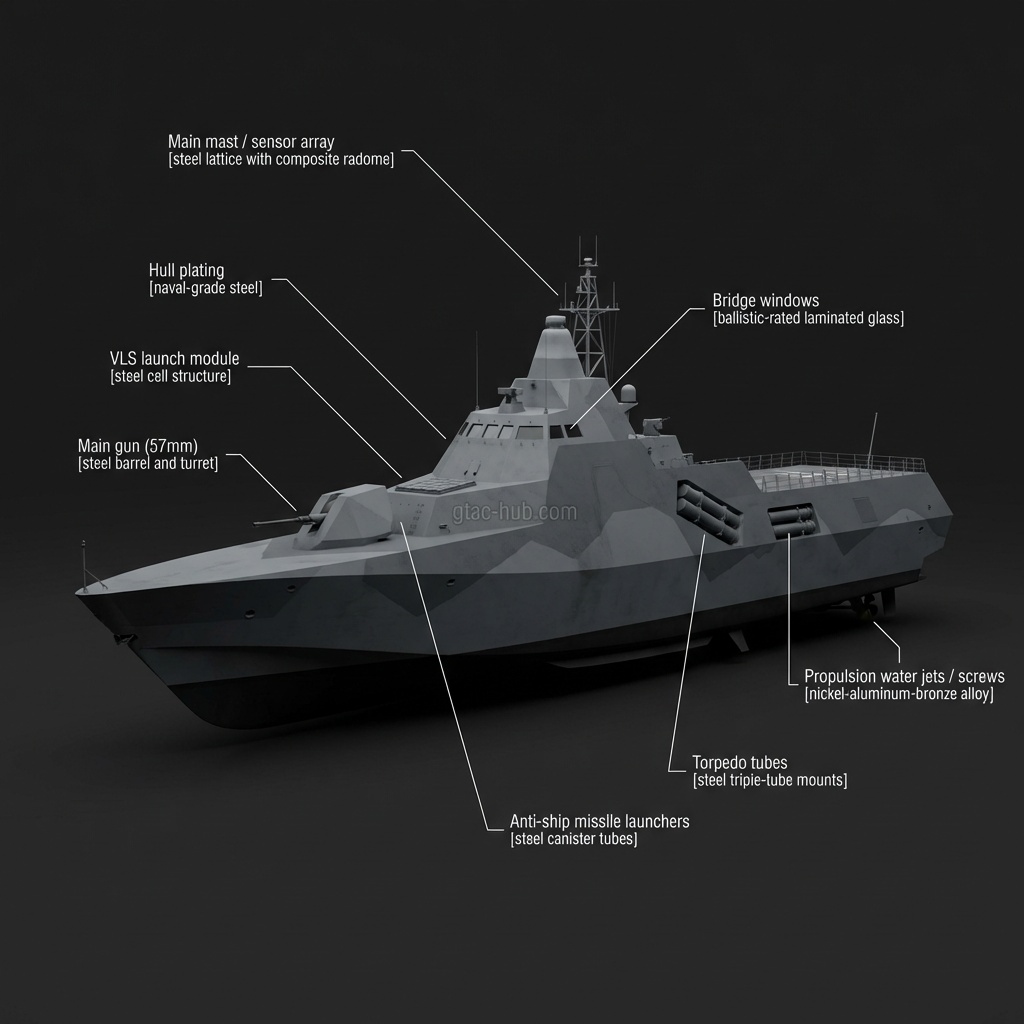
World's first stealth corvette and one of the most innovative warship designs globally, featuring full carbon-fiber composite hull and superstructure for minimal radar cross-section. The Visby class displaces 640 tonnes with length of 73 metres. The entire hull and superstructure are constructed from carbon-fiber-reinforced plastic (CFRP) providing stealth characteristics, reduced weight, and non-magnetic signature for mine countermeasures. Radar cross-section reportedly comparable to a small fishing boat despite corvette size. Armed with Bofors 57mm Mk3 naval gun, 4x RBS 15 Mk3 anti-ship missiles (200+ km range), depth charges, and provisions for surface-to-air missiles. Propulsion via 4 waterjets powered by diesel and gas turbines for 35+ knots. The design emphasizes stealth, speed, and survivability in shallow Baltic Sea operations. Five boats in class: Visby, Helsingborg, Härnösand, Nyköping, and Karlstad — entering service 2009-2015. The Visby demonstrated revolutionary composite construction for naval vessels, though the initial production run was limited by cost. Sweden is developing Visby Generation 2 with heavier armament and larger displacement.

- World first operational stealth warship; carbon-fiber composite hull
- Extremely low RCS, IR, and magnetic signatures
- Fast (35+ knots) and agile for littoral combat
- Effective ASW platform for shallow-water Baltic operations
- Very small (640t); limited seakeeping in open ocean
- No area air defense capability; only point defense
- Small weapons loadout; limited sustained combat capability
- 5 ships insufficient for Sweden expanded Baltic commitments post-NATO accession
Sign in to join the discussion and rate this weapon system
SIGN INNo comments yet. Be the first to share your analysis.

