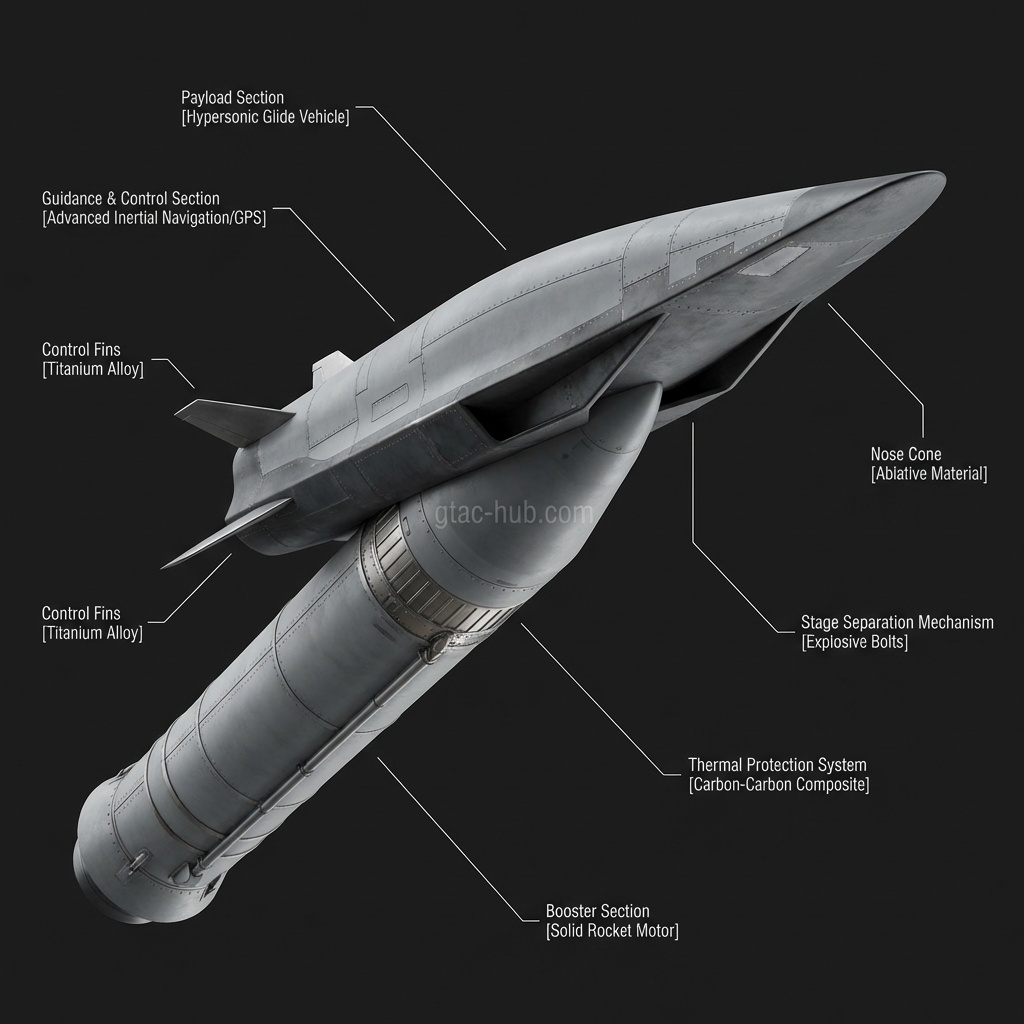
HGV (Hyper Velocity Gliding Projectile)
Type: missile
Domain: land
Country of Origin: Japan
Manufacturer: Japanese Defense Industry
Overview
Japan's indigenous hypersonic weapon programme developing a boost-glide vehicle for island defence and anti-ship operations. The HGV is launched by a solid-fuel rocket booster to high altitude, where it separates and glides at hypersonic speeds (Mach 5+) toward the target, manoeuvring during the glide phase to evade missile defences. Two variants are under development: the Early Deployment Type optimised for island recapture operations with a penetrating warhead for hardened targets, and the Improved Type featuring an anti-ship seeker for engaging enemy warships at ranges exceeding 1,000 km. The programme is managed by Japan's Acquisition, Technology & Logistics Agency (ATLA). Testing has been ongoing with the first operational deployment planned for the mid-2020s. Japan is one of only a handful of nations actively developing hypersonic glide vehicles, reflecting the urgency of countering peer threats in the Western Pacific.
Technical Specifications
| role | Anti-ship; island defense; land attack |
|---|---|
| type | Hypersonic Glide Vehicle |
| range | ~500-1,000 km (estimated) |
| speed | Hypersonic (Mach 5+) |
Operators
- Japan (JGSDF — planned)
Related land Weapon Systems
- PzH 2000 - Self-Propelled Howitzer (Germany)
- Leclerc - Main Battle Tank (Germany)
- PT-91 Twardy - Main Battle Tank (Poland)
- BMP-2 Infantry Fighting Vehicle - Infantry Fighting Vehicle (Russia)
- T-62M Main Battle Tank - Main Battle Tank (Russia)
- BTR-4 Bucephalus - Wheeled Armored Vehicle (Ukraine)
- Puma IFV - Infantry Fighting Vehicle (Germany)
- Challenger 2 - Main Battle Tank (United Kingdom)
- TAM VCTP Infantry Fighting Vehicle - ifv (Argentina)
- VBCI - armored_vehicle (Germany)