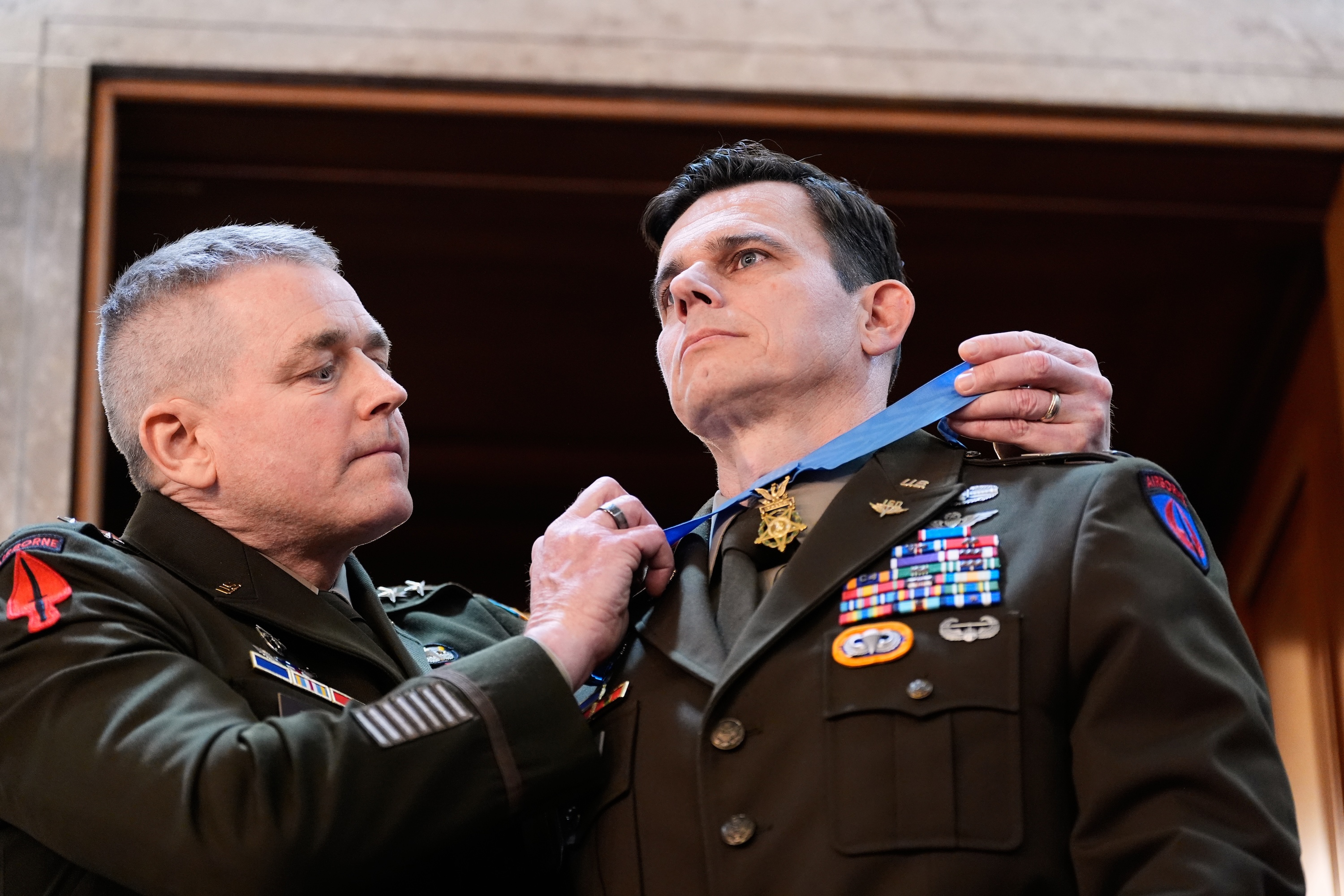
Chief Warrant Officer 5 Eric Slover was awarded the Medal of Honor for his distinguished service as the flight lead aboard the first Chinook helicopter during a raid on Venezuelan President Nicolás Maduro's compound. During this operation, Slover suffered injuries but demonstrated exceptional bravery in guiding his team through hostile airspace, ensuring the successful insertion of ground forces. The award was presented during a State of the Union address, emphasizing the significance of personal sacrifice in military operations.
The recognition of Slover's actions is pivotal in the context of U.S. foreign policy towards Venezuela, where unrest and allegations of human rights abuses have created a volatile environment. This operation underscores the strategic interest of the U.S. in restoring democracy in Venezuela and its willingness to engage militarily to support these efforts. The situation remains a focal point of international concern, particularly for regional actors in South America and beyond.
Key players in this scenario include the U.S. military and the Venezuelan government. The U.S. has increasingly supported opposition forces in Venezuela, reflecting a commitment to countering authoritarian regimes in the region. Conversely, Maduro's government views U.S. involvement as a direct threat to national sovereignty and has positioned its military in readiness against perceived incursions.
The global implications of this operation are significant. Recognition of Slover's heroism may enhance U.S. morale and support for military involvement, potentially leading to further escalations in Venezuela. Regional allies may also reassess their security posture in light of continued U.S. engagement in Latin America, while adversarial nations may perceive this as a pretext for enhanced militarization of their own forces.
Historically, U.S. military operations in Latin America have had mixed outcomes, often leading to prolonged conflicts and geopolitical instability. As the situation develops, analysts will closely monitor how these events influence U.S. defense strategies and regional security partnerships moving forward.
Analysts anticipate continued military involvement in Venezuela, particularly if internal conflicts escalate. The recognition of acts of valor may serve to galvanize support for ongoing military operations in the region as the U.S. seeks to stabilize its interests in the face of rising authoritarianism.