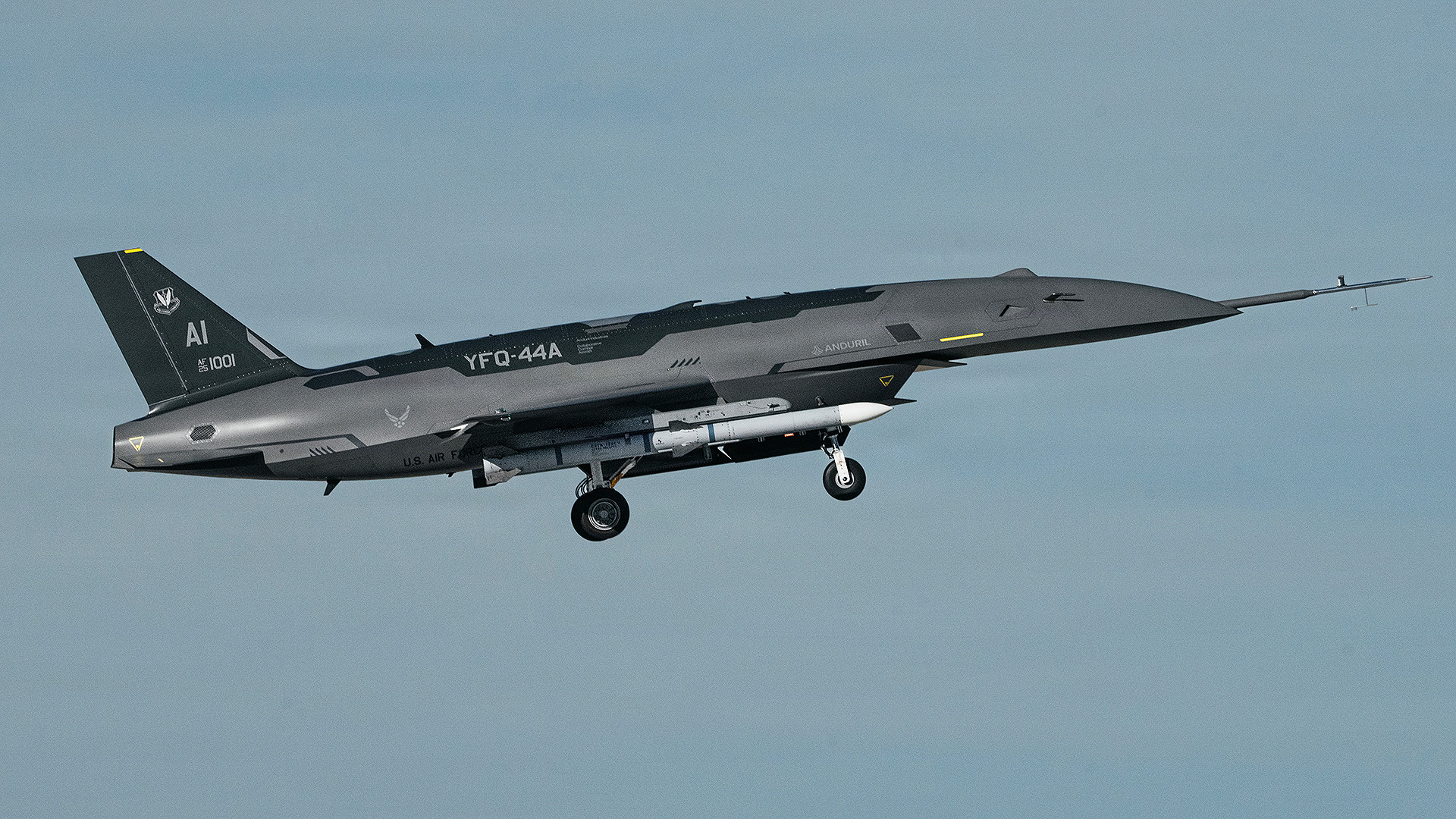
The United States Air Force (USAF) has announced that its YFQ-44A Fury unmanned aerial vehicle (UAV) has begun test flights equipped with the AIM-120 Advanced Medium-Range Air-to-Air Missile (AMRAAM). This phase of the Collaborative Combat Aircraft (CCA) program focuses on weapons integration and captive carry testing, a critical step towards operational capability for advanced drone warfare. Specific details on the number of tests conducted or the exact payload configurations have not been disclosed by the USAF.
Strategically, the integration of the AIM-120 missile system onto the YFQ-44A Fury positions the USAF to enhance its air superiority measures during modern combat. As adversaries develop and deploy more advanced aerial threats, the USAF's ability to command the skies with unmanned systems equipped with precision-guided munitions is becoming increasingly vital to maintaining regional and global military dominance.
Key players in this development include the USAF, which is prioritizing the rapid advancement of drone technologies in response to evolving threats. Defense contractors involved in the CCA program, such as Northrop Grumman and Boeing, are motivated to innovate and deliver capabilities that align with the USAF's vision. This drive for modernization emphasizes the importance of unmanned systems in future warfare and deterrent strategy.
The successful integration of the AIM-120 AMRAAM on the YFQ-44A Fury has global ramifications, particularly in terms of how future conflicts will be fought. Increased drone capabilities could alter the balance of power and provoke responses from nations closely monitoring US advancements. Potential adversaries may accelerate their own UAV development programs to counter enhanced capabilities from the USAF, leading to an arms race in unmanned aerial systems.
Historically, advancements in air combat technology have often led to significant shifts in military strategy. The development and deployment of precision-guided munitions and advanced UAVs have already transformed warfare, making it essential for nations to adapt to these changes in order to retain a competitive edge.
Analyst assessment indicates that as the USAF continues to test and refine the YFQ-44A with integrated weaponry, the implications for modern aerial combat will be profound. Increased investment in drone technology may not only enhance US operational effectiveness but also influence coalition partners and adversaries in their defense postures and military planning.