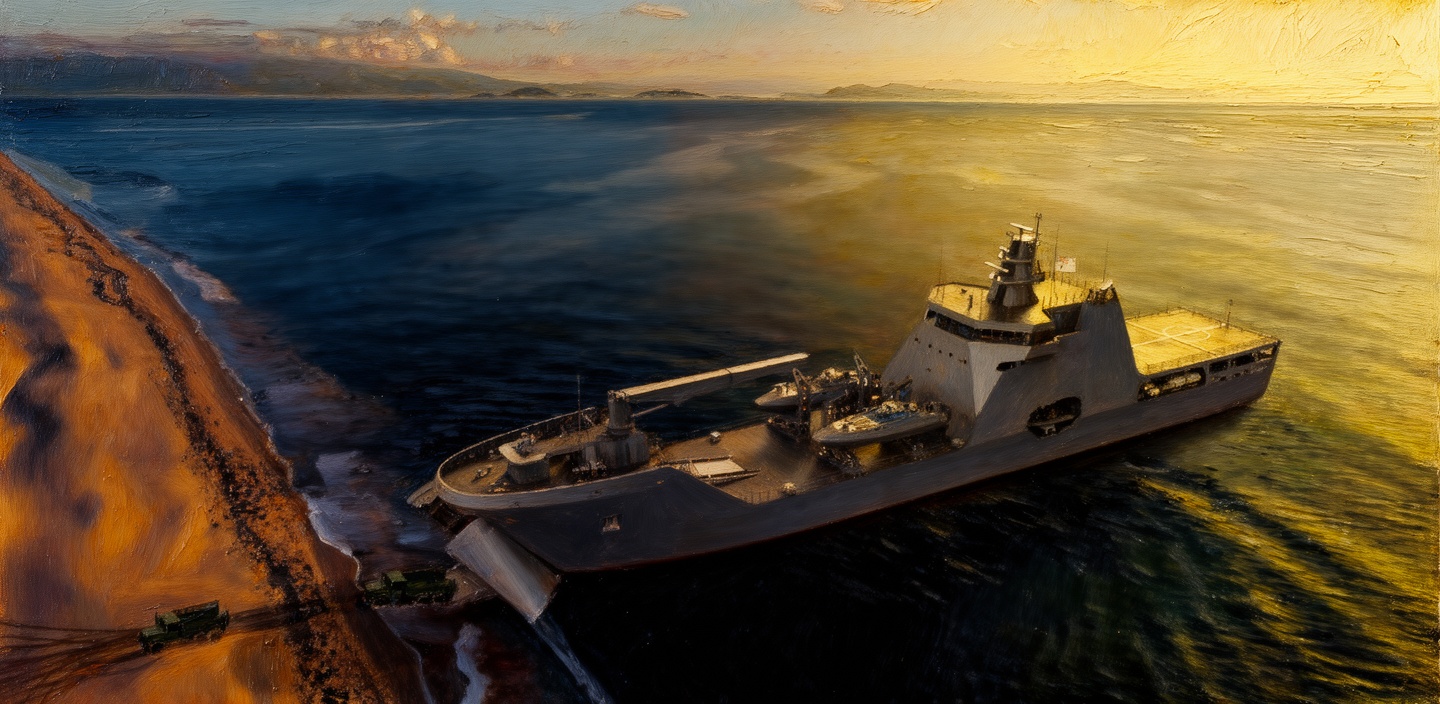
US Marines Unveil Medium Landing Ship Design
A new Medium Landing Ship concept promises to ferry troops, gear, and supplies to shore without established ports. The design signals a shift in amphibious projection, emphasizing flexibility and rapid access to contested coastlines. Analysts will watch for cost, survivability, and integration with existing fleets.
The United States Marine Corps has released footage of a new Medium Landing Ship design intended to deliver troops, equipment, and supplies directly to shorelines lacking port access. The video showcases a modular hull with a reduced footprint compared to traditional L-Class ships, suggesting faster construction and easier maintenance. The vessel is positioned as a force-mprojection enabler, designed to penetrate littoral zones under contested conditions without relying on preexisting port facilities. The release emphasizes mobility, survivability, and rapid load-out, signaling a renewed emphasis on sea-denial environments where forward basing is untenable.
Contextually, this development comes amid broader debates over amphibious warfare doctrine, especially in theaters where port access is unreliable or contested. The concept aligns with a growing preference for offloaded, distributed forces that can appear ashore in multiple locations almost simultaneously. It mirrors a trend toward smaller, more versatile ships that can operate in shallow waters while sustaining sustained supply lines. Analysts note that the design may complement larger amphibious ships by providing a faster, more agile entry point for follow-on forces.
Strategically, the Medium Landing Ship could reshape how the Marines project power along contested coastlines, reducing reliance on massive pre-staging and port facilities. If adopted at scale, it would complicate adversaries’ anti-access/area-denial calculations by presenting more potential landing points. The platform could also enable rapid humanitarian assistance and disaster relief in parallel with combat tasks, though the focus remains military. The emphasis appears to be on operational resilience and timing, not on replacing larger ships entirely.
Technical and operational specifics remain scant in the released material, but the concept highlights modularity, crew efficiency, and potential for quick upgrade cycles. Observers expect integration with air and naval assets to provide mutual support, including airborne deployment and fire support coordination. Budgetary signals will determine how quickly this concept advances beyond concept phase, with procurement choices likely to favor a mix of autonomy, manned operation, and evolving unmanned systems. The exact propulsion, armament, and survivability measures are to be disclosed in later program milestones.
Looking forward, the Medium Landing Ship design will undergo rigorous testing, with potential trials in littoral environments to validate sea-keeping and load-out flexibility. If the platform proves adaptable to multiple theaters, it could accelerate amphibious operations and tighten perception gaps between sea-based maneuver and inland objectives. However, production costs, maintenance demands, and interoperability with existing fleets will shape whether the concept becomes a standard asset or a limited deployment capability.