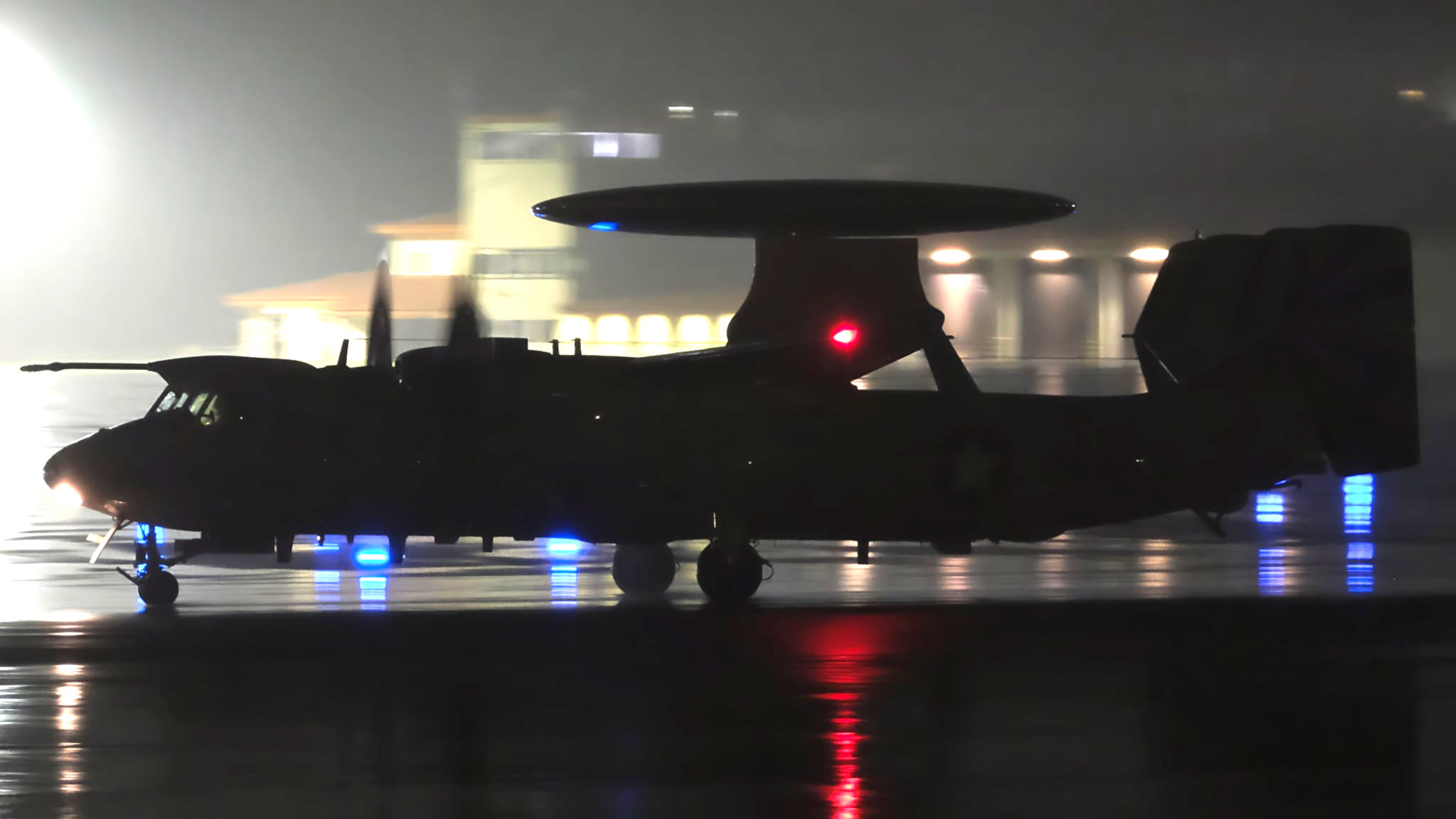
US Deploys E-2D Hawkeye Radar Jets to Persian Gulf Crisis
The urgent deployment of US Navy E-2D Hawkeye early warning aircraft to the Persian Gulf signals escalating concern over Iranian drone and missile threats targeting Gulf Arab states. The move positions the US as a critical actor in regional air defense, raising the stakes amid ongoing attacks.
The United States has rapidly deployed Northrop Grumman E-2D Hawkeye airborne early warning aircraft to the Persian Gulf as Gulf Arab states face surging Iranian drone and missile attacks. This operation marks a clear escalation in US involvement in the region’s air defense architecture, as Iranian proxies continue to strike critical oil infrastructure and military sites with increasing frequency.
The context for this deployment is months of mounting Iranian drone and missile activity across the Gulf, particularly against targets in Saudi Arabia and the UAE. Attacks by groups linked to Iran, such as Yemen’s Houthis, have repeatedly targeted oil facilities and civilian airports, evading local point-defense systems. Previous US air defense efforts in the region have focused on Patriot batteries and Aegis ships, but persistent low-flying threats exposed major surveillance gaps.
This development is a critical reinforcement of the Gulf’s early warning and air command capabilities, as the E-2D is equipped with the AN/APY-9 radar—one of the most advanced all-weather airborne early warning systems globally. Its 360-degree coverage is especially effective for identifying small, low-flying drones and cruise missiles that routinely bypass ground-based radars in the region. The US decision to rush these assets highlights the scope of the threat and a potential tipping point in Iranian power projection.
Key players include the US Navy, which controls the deployed E-2D detachments, regional Gulf partners under pressure to protect vital infrastructure, and Iran alongside its proxy forces whose actions continue to destabilize the operating environment. Washington's publicly stated rationale is "regional stability," but the move is better explained as a direct counter-escalation to Iranian entrenchment and technological adaptation in drone warfare.
Technically, the E-2D Hawkeye operates with a crew of five, supporting detection ranges over 550km depending on target signature. The AN/APY-9 AESA radar can track more than 2,000 targets simultaneously and control up to 40 friendly interceptors. The aircraft's data-fusion and networking capability allow real-time coordination between multiple GCC and US air assets. The value of a single E-2D is over $170 million, with operational deployment sourced from Carrier Airborne Early Warning Squadrons.
Regionally, this shift in US posture is likely to harden regional defense alliances and provoke further Iranian countermeasures, raising the risk of direct clashes or miscalculation. Tehran is expected to test the system’s limits, possibly with swarming attacks or new drone types designed to evade radar acquisition. Gulf partners may pressure Washington for even deeper integration or expanded deployments of other US intelligence and surveillance assets.
The crisis has echoes of multiple US-Iran standoffs in the Gulf, such as tanker attacks in 2019 and the shootdown of a US RQ-4 Global Hawk near the Strait of Hormuz. In each prior case, escalation was punctuated by advances in Iranian air and maritime asymmetric capabilities and the US response with high-end ISR platforms.
Intelligence indicators for further escalation include open-source tracking of E-2D flight patterns, Iranian state media threats, rapid movement of additional US C2 or air defense assets, and intercepted communications about new proxy operations. GTAC will closely monitor regional airspace changes and emerging counter-deployment by Iranian-aligned groups.