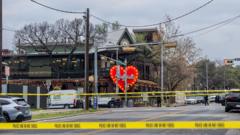
Texas Bar Shooting Leaves Three Dead, 14 Wounded in Austin Chaos
A calculated attack at a crowded Texas bar exposes glaring vulnerabilities in domestic security. With the shooter dead and more casualties, the violence raises urgent questions about gun laws and public safety.
Three people are dead and 14 others injured following a brazen shooting at a popular bar in Austin, Texas. The incident unfolded in the early hours of Sunday morning when an assailant, after driving an SUV to the venue, opened fire with a pistol on patrons enjoying the bar's outdoor seating. After initially attacking from his vehicle, the shooter exited armed with a rifle and continued the assault, further escalating the violence before ultimately taking his own life.
This incident is the latest example of escalating gun violence in the United States, where mass shootings have become alarmingly frequent. The assailant's approach—ambushing an unsuspecting crowd—is reminiscent of tactics employed in previous, high-casualty attacks. The frequency of such incidents raises serious concerns about safety protocols in public spaces and the effectiveness of existing gun control measures.
Strategically, this shooting exposes significant vulnerabilities in protecting soft targets across urban areas. Given the growing prevalence of firearms in the civilian population—estimated at over 390 million guns—local law enforcement may be ill-equipped to respond to such fast-evolving threats, raising the specter of further violence. The repeated failure to curtail gun violence threatens public trust in security forces and has implications for community resilience against violent extremism.
Key actors in this crisis include local law enforcement and city government officials, whose attempts to address gun violence policies have faced resistance from pro-gun advocacy groups in Texas. The governor and state legislature have long maintained a pro-gun stance, complicating any push for stricter regulations. This instance of gun violence may illuminate schisms within the political landscape, possibly energizing movements seeking reform.
Technical aspects of the shooting reveal the dire operational challenges facing law enforcement. The shooter was reportedly armed with a pistol and an assault weapon, adding to the lethality of the situation. While exact figures for the firearms in public circulation vary, estimates suggest that Texas ranks among the top states for gun ownership and concealed carry permits, complicating the regulatory landscape.
The likely consequences of this incident are manifold. Apart from immediate security concerns, it may trigger a renewed debate over gun control in Texas and nationwide. If state lawmakers fail to act decisively on regulations, public protests are probable, along with increased scrutiny of law enforcement's preparedness to handle similar crises in the future.
Historically, incidents like this serve as grim reminders of previous mass shootings in the U.S., such as the Pulse nightclub shooting in 2016 and the Las Vegas shooting in 2017, both resulting in significant casualties and subsequent policy debates. Each incident ignites public outcry but often leads to limited legislative action, despite vocal demands for change.
Looking ahead, attention should be paid to the calls for policy reform and how political leaders address the situation in the aftermath of this shooting. Indicators to watch will include public sentiment shifts, responses from advocacy groups, and potential legislative proposals focused on addressing gun violence in Texas and nationally.