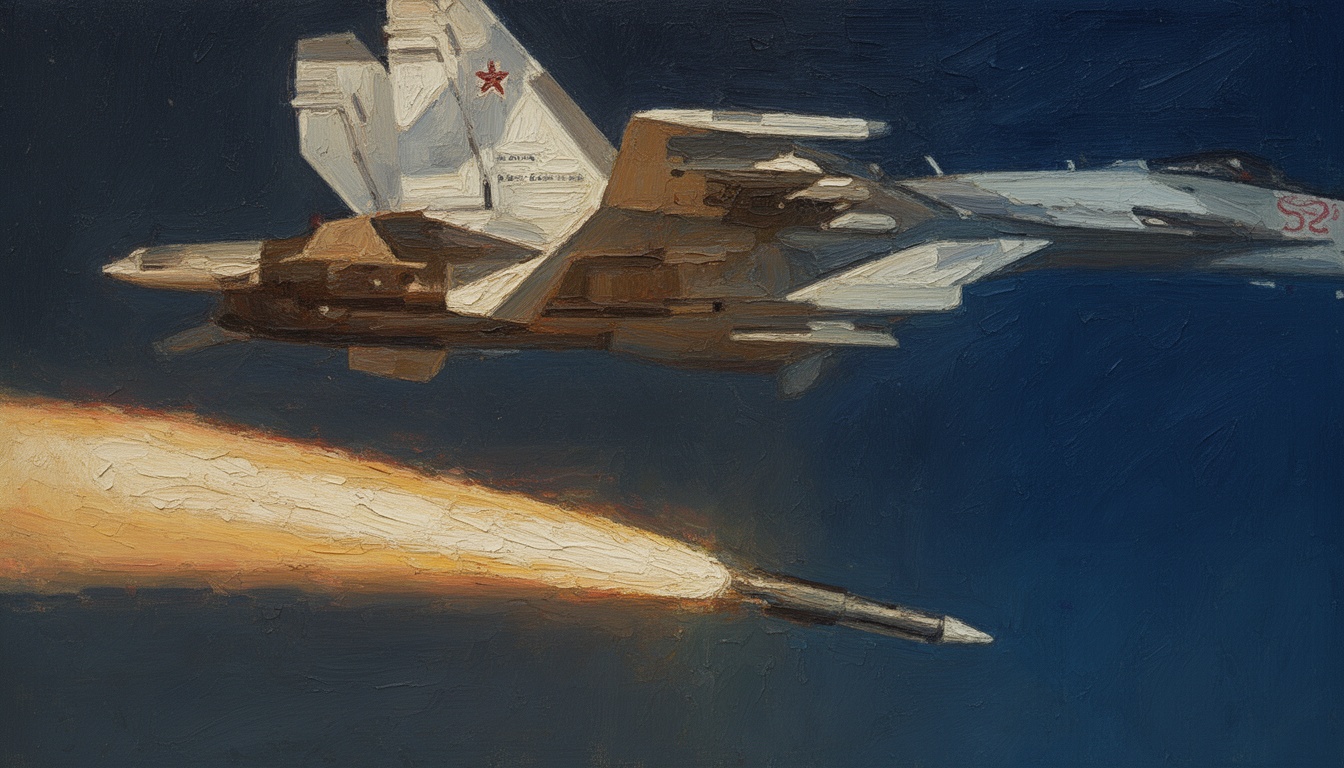
Russia to Supply 300 R-37M Missiles to India for Joint Air Defences
India inks a US$1.2 billion export deal for roughly 300 R-37M ultra-long-range air-to-air missiles aimed at countering rival air profiles from Pakistan and China. Deliveries could begin in 12–18 months as Delhi advances its domestic Astra Mk 2/3 programs and regional air combat deterrence increases.
A major arms export has potential to recalibrate South Asia’s air power balance. New logistics and integration steps accompany India’s acquisition of approximately 300 R-37M missiles, designed for high-kinetic, long-range air-to-air engagements. The deal underscores a push to soften the qualitative gap against accelerating adversary aerial capabilities, particularly in contested airspace near the Himalayan frontiers and western seas. Primary emphasis remains on extending intercept and stand-off engagement envelopes to complicate adversaries’ air operations.
Context for this acquisition lies in the evolving triad of regional threats. Pakistan and China have broadened their joint and parallel air weapons development, with common interests in extended-range missiles and defensive countermeasures. The Russian export clearance signals a strategic permission for India to diversify its missile boutique beyond indigenous production and limited Western supply routes. This shift occurs as New Delhi doubles down on multi-source resilience for its air force infrastructure.
Strategically, the missiles strengthen air superiority calculus for India in a region where airspace control can decisively influence foothold gains, interdiction, and air diplomacy. The R-37M’s range and performance profiles are intended to complicate enemy aerial ingress and reduce penetration success for rival formations. The move also refracts into Islamabad and Beijing’s strategic calculations, potentially prompting earlier or more robust diversification of their own air-to-air and surface-to-air concepts.
Technical and operational details illuminate the footprint of this alignment. The 300 missiles are valued at about $1.2 billion, signaling a high-end procurement with substantial logistics, spares, and training packages likely included. Deliveries expected within 12 to 18 months would necessitate parallel upgrades to launchers, fire-control interoperability, and integrated Air Force command-and-control interfaces. India’s Astra Mk 2 and Mk 3 programs remain central to domestic ambitions for autonomous, next-generation air weapons with a focus on beyond-visual-range engagements and enhanced kinematic performance.
Forecasts point to a more layered regional security environment. Russia’s willingness to export such a strategic system to India enhances New Delhi’s deterrence credibility, while complicating Pakistan-China air-coordination and willingness to accept parity in specific mission sets. If timelines hold, the next 24–36 months could see accelerated investments in training pipelines, maintenance ecosystems, and joint drills that stress cross-domain interoperability across Indian, Russian, and allied platforms. Escalation risks hinge on how adversaries adapt their air forces and whether they shift to more dispersed, multi-domain tactics that degrade bomber-and-escort sortie effectiveness.