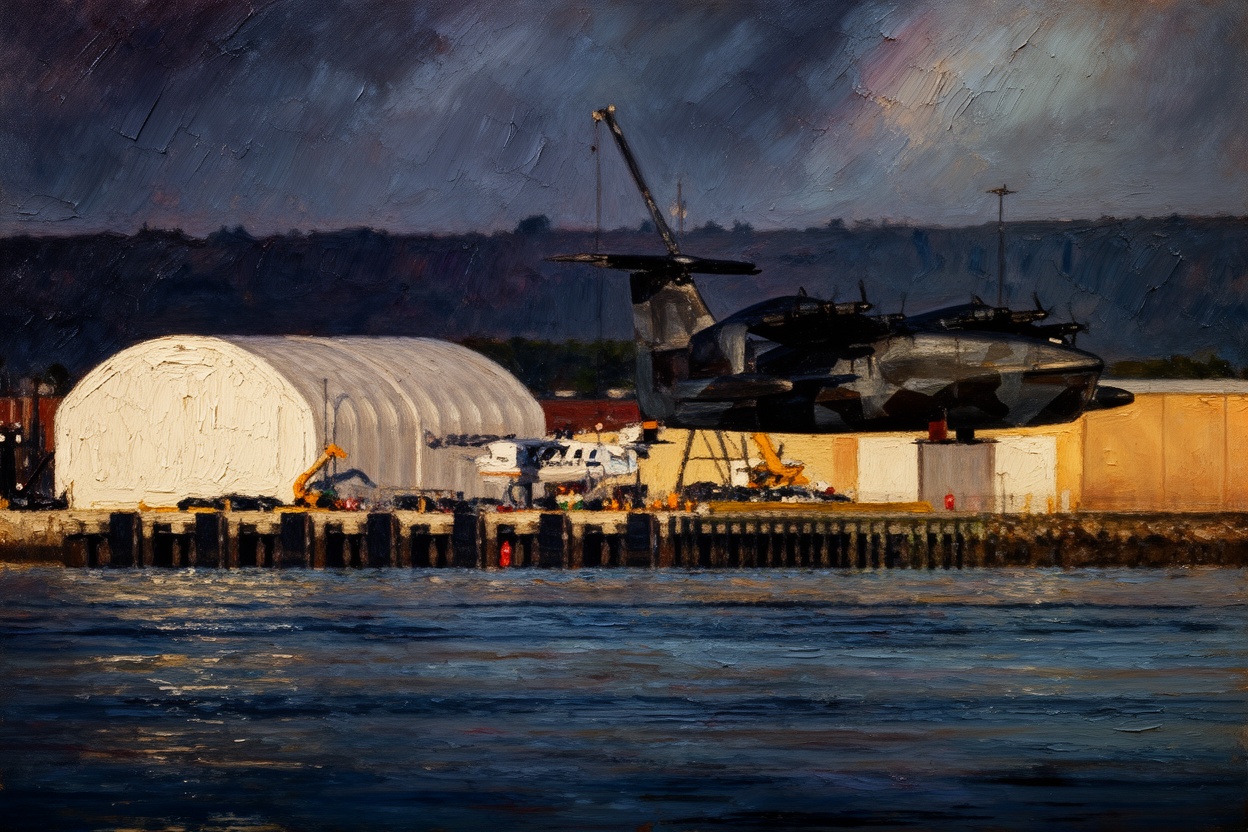
REGENT Squire Seaglider Executes Ground-Effect Flight
REGENT's Squire demonstrates ground-effect flight for a defense-focused wing-in-ground-effect drone. The milestone intensifies U.S.-China tech competition in a strategic marine domain. Analysts see potential shifts in littoral ISR, maritime patrol, and anti-access/area-denial dissuasion capabilities.
The first ground-effect flight of REGENT’s Squire, a defense-specific Seaglider drone, marks a bold proof-of-concept for wing-in-ground effect craft in American defense testing. REGENT asserts the autonomous drone completed a controlled flight within its ground-effect envelope, a flight profile designed to maximize lift and efficiency over shallow water. This early demonstration signals progress toward a potentially disruptive class of maritime sensors and armed or sensor-enabled unmanned vehicles. The achievement underscores the strategic push to own a niche in a domain traditionally dominated by larger manned systems and ships.
Background: Wing-in-ground effect technology has historical roots in European and Asian developments, but recent U.S. programs emphasize autonomous, persistently capable systems for coastal and contested environments. REGENT’s approach integrates compact propulsion, advanced autonomy, and sea-skimming flight within a confined air-water interface. The Squire program is positioned to complement larger unmanned platforms, potentially enabling rapid intelligence, surveillance, and reconnaissance in contested littoral zones. The demonstration occurs amid heightened attention to how emerging drone classes reshape deterrence and forward presence.
Strategic significance: Ground-effect solutions offer extended range and endurance in shallow maritime theaters, strengthening the U.S. ability to monitor coastlines, chokepoints, and disputed harbors. If mature, these craft could complicate adversary anti-access environments, complicating fleet deployments and joint ISR operations for near-shore zones. The United States and allied partners view such technology as a force multiplier for maritime domain awareness, potentially influencing future ship and aircraft carrier risk calculations in gray-zone coercion scenarios.
Technical details and capabilities: REGENT positions Squire as a compact, autonomous wing-in-ground-effect craft specialized for defense missions. While detailed specifications remain undisclosed, the device is described as an unmanned, sea-skimming vehicle optimized for lift, payload flexibility, and low-speed flight within a ground-effect corridor. The flight test reportedly focused on stability, control algorithms, and propulsion management in a coastal setting, providing useful data for scalability and certification processes. Analysts will watch for subsequent demonstrations that reveal payload options, endurance, and integration with existing ISR ecosystems.
Forward assessment: The ground-effect milestone adds a new vector to the U.S. maritime reconnaissance and situational awareness toolkit. If Squire progresses toward broader testing and export-ready variants, it could influence regional power dynamics in the Indo-Pacific and Atlantic littorals. Washington will likely pair this development with allied drone standards, access to shared data links, and risk-management measures to address potential adversary countermeasures. The broader implication is a more diverse US unmanned maritime fleet capable of sustaining operations in congested coastal regions under intensified pressure from near-peer competitors.