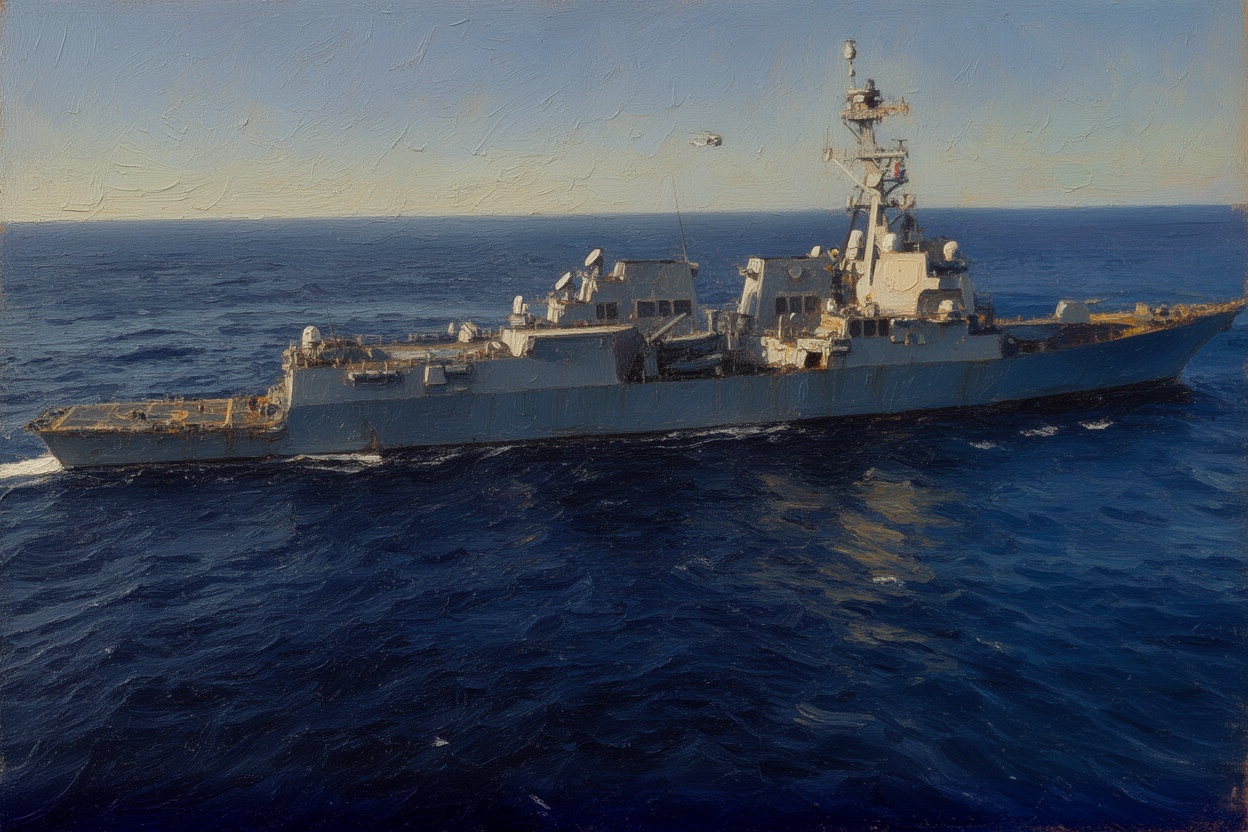
Mystery U.S. Navy Launcher Identified as Upgraded Coyote Missile Launcher
The USS Carl M. Levin (DDG 120) now carries an upgraded Coyote Counter-UAS launcher, the first dedicated shipboard Raytheon C-UAS launcher confirmed on a U.S. Navy ship. The development signals an increasingly capable, shipborne counterdrone capability at sea. The fielding points to a broader push to harden surface combatants against unmanned aerial threats amid rising regional contest.
An upgraded Coyote Counter-UAS (C-UAS) launcher has been installed on the Pearl Harbor-based USS Carl M. Levin (DDG 120). This marks the first known dedicated shipboard launcher for Raytheon’s combat-proven C-UAS on a U.S. Navy warship. The installation suggests a deliberate move to normalize shipborne counterdrone defenses on existing destroyers in high-threat environments. The Navy has faced persistent gaps in C-UAS integration as it expands fleet air defense layers against inexpensive, unmanned threats.
Contextually, the Carl M. Levin upgrades come as the U.S. Navy accelerates its efforts to integrate modular, hardware-in-the-loop drone countermeasures into surface ships. The programmatic emphasis follows a series of assessments and limited operational experiences that highlighted gaps in endurance, engagement range, and interoperability with other air-defense systems. Even with rapid prototyping, the service has repeatedly emphasized the need for scalable, field-ready solutions that can be deployed without heavy logistics burdens.
Strategically, the move reinforces deterrence in the Pacific theater where unmanned threats—whether surveillance drones or loitering munitions—pose a growing risk to carrier strike groups and amphibious task forces. A shipboard C-UAS capability complicates adversary calculations by raising the cost and difficulty of drone-based reconnaissance and attack campaigns. It also signals potential future upgrades to other destroyers and frigates that rely on similar launchers for standardized C-UAS effects.
Technical details remain partial, but the launcher is described as an upgraded variant designed for faster reloads, improved stabilization, and compatibility with Raytheon’s C-UAS family. The system likely integrates with existing close-in defense networks and could leverage modular pods to handle different drone classes. If this launcher proves effective, it could drive budgetary priorities toward broader sea-based C-UAS redundancy, sensors fusion, and data-sharing with allied fleets.
Looking ahead, the fielding of an upgraded shipboard Coyote launcher on a U.S. destroyer foreshadows expanded experimentation with autonomous effects in naval air defense. Expect further ship tests and potential cross-ship standardization as the Navy seeks to close current capability gaps while maintaining prudent logistics and maintenance footprints. The outcome will influence how surface combatants contribute to joint all-domain defense campaigns in contested environments.