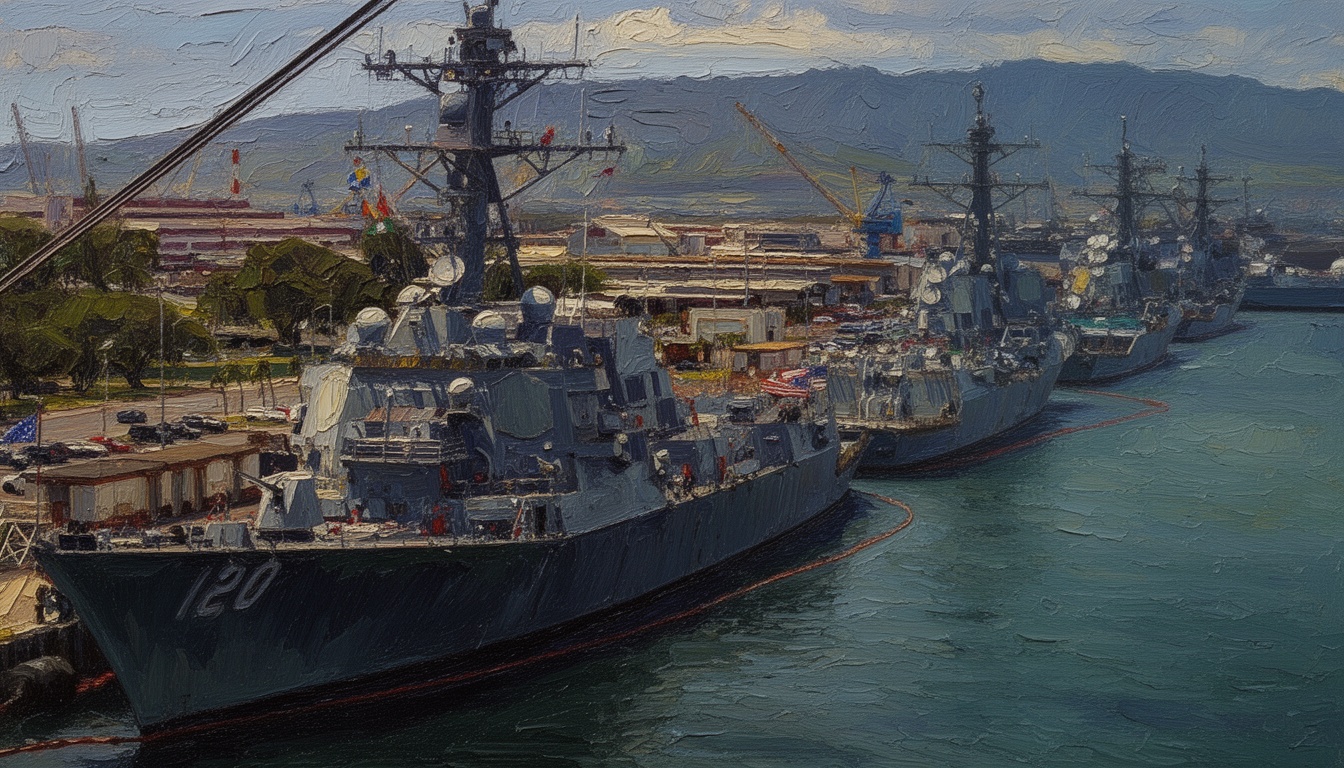
Mystery Launcher Appears On U.S. Navy Destroyer
The Arleigh Burke class destroyer USS Carl M. Levin has received a mysterious aft-deck launcher with no official designation. The Navy has not commented; observers view it as a test or demonstrator. Analysts will monitor for further disclosures and any tests.
The Arleigh Burke-class destroyer USS Carl M. Levin shows a conspicuous modification on its aft upper deck, where an unidentified launcher has appeared. The launcher’s form and mounting suggest a purpose distinct from standard CIWS or conventional missile tubes, though no official designation has been released. This development enters a domain of high secrecy, and observers should treat the sighting as part of a test program rather than a fully deployed capability. The absence of an official statement means this is likely a controlled demonstration or test rather than an operational system.
Context around post-2010s U.S. surface warfare experiments reveals a pattern of modular payloads and containerized launchers on existing hulls. In this case, the Carl M. Levin’s patrol and anti-submarine duties, plus carrier-strike compatibility goals, naturally fuel interest in any aft-deck arming concept. The lack of public disclosure increases the likelihood that this is a controlled test rather than a fielded weapon. The event thus sits at the intersection of confidentiality and operational signaling in modern naval warfare.
Strategically, the appearance of an unidentified launcher could be read as a probe into modular payloads and deterrence. If proven compatible with current architectures, it could signal a move toward rapidly reconfigurable munitions for surface combatants in blue-water fleets. The ambiguity may serve deterrence by implying that even mid-sized destroyers can host unconventional arming concepts. The regional balance of power in contested littoral zones could shift if new surface-to-surface or air-defense tasks emerge.
Technical details remain scarce, but visible integration points point to a compact, modular arrangement. The launcher’s geometry hints at a containerized or mission-adaptable module, potentially for short-range missiles or kinetic interceptors. If confirmed, the system would require data-sharing integration with the ship’s combat system and sensors to maintain fire-control coherence. Budget or procurement disclosures are unlikely in the near term given classification practices; this could be a prototype for a family of munitions or a limited demonstrator.
Forward assessment suggests this launcher may be a test-bed for future derivatives or a limited demonstrator to assess maintenance and crew proficiency. It will likely prompt inquiries in congressional and industry circles about potential investment in the system’s ecosystem. In the near term, expect heightened interest from EW and electronic warfare communities to understand how a deck-level launcher affects radar resilience and target-tracking. The coming months may bring more imagery or official clarifications that determine whether this is a niche test or a step toward broader capability enhancements.