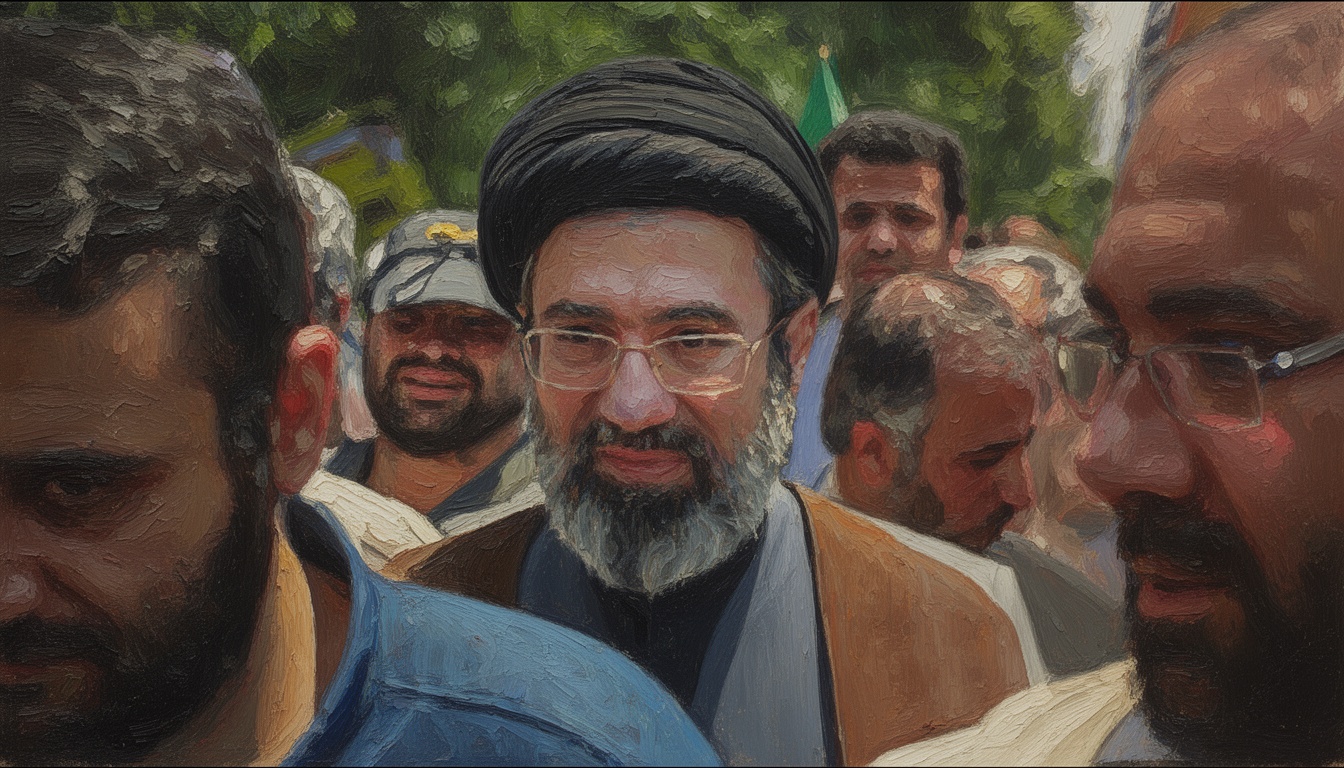
Mojtaba Khamenei Largely Hidden After Strike
Speculation swirls around Mojtaba Khamenei’s status and influence after the strike that killed his father. He reportedly stays out of sight and participates in decisions via handwritten notes, raising questions about leadership dynamics inside Iran. The situation signals potential shifts in internal power balance with broad regional implications.
Mojtaba Khamenei has remained largely out of public view since the strike that killed his father nearly two months ago, fueling intense speculation about his condition and role. Reports suggest he has chosen to live in hiding, driven by fears for his life and the desire to preserve influence without public visibility. Observers note that decision making is reportedly conducted through handwritten notes, a method that constrains rapid, collective guidance from the inner circle. The lack of appearances by a hereditary successor or de facto power broker creates a vacuum at the apex of Iran’s political-security system.
Background has long held that Mojtaba’s influence within the Iranian leadership has been significant, even if not formally acknowledged. The current structure concentrates authority around the supreme leadership and a tight network of senior clerics and security officers. The strike that killed the elder Khamenei acted as a shock event, intensifying debates about the future trajectory of Iran’s command-and-control with respect to nuclear, foreign, and security policy. In this context, visibility in public channels does not guarantee influence; the real lever remains control over selective channels and personal loyalty networks.
Strategically, the situation matters because it tests the resilience of Iran’s succession mechanisms and command authority. If Mojtaba’s rumored elevation is confined to a hidden calculus, it could embolden factional maneuvering within the system and unsettled coordination across the security establishment. Regional actors will watch for signs of a shift in deterrence postures, leadership signaling, or changes in how hard-line and conservative elements calibrate their messaging. Any perception of a contested leadership could alter Iran’s risk calculations in neighboring theatres, including the Gulf and Iraq.
Operationally, the absence of a visible successor complicates messaging and crisis management capabilities in Tehran. While the leadership contingent reportedly relies on coded communications and private deliberations, real-time response to external pressures may suffer from delays and ambiguity. Budgetary and defense-industrial decisions could experience a tilt toward more clandestine or expedited processes, as senior officers seek to lock in support before any formal consolidation. This dynamic may influence Iran’s strategic posture, including its ballistic missile development, cyber operations, and regional proxies.
Looking ahead, the most likely trajectory involves prolonged ambiguity around Mojtaba Khamenei’s status and a gradual stabilization of the leadership narrative through controlled appearances or decisive, symbolic moves. If the leadership remains bifurcated between outward appearances and private decision channels, regional rivals may test Tehran’s thresholds, probing for missteps or miscommunication. The broader security environment could tilt toward heightened vigilance and more cautious diplomacy from Tehran, while internal power struggles risk periodic bursts of unpredictability that affect Iran’s external behavior and alliance calculus.