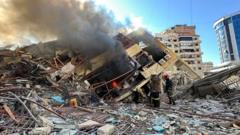
Lebanon Faces Escalating Violence as Calls for Talks with Israel Increase
Lebanon's appeal for dialogue comes during a critical surge in Israeli strikes targeting Hezbollah, heightening regional tensions. The ongoing conflict raises significant risks for national security and stability in Lebanon and beyond.
Lebanon's President Michel Aoun has called for urgent talks with Israel to address ongoing military tensions, as Israeli strikes against Hezbollah intensify. This initiative appears to be a desperate attempt to navigate a rapidly escalating conflict that risks dragging the entire region into further chaos. As violence mounts, the hope for a diplomatic resolution seems tenuous at best, with both sides likely to remain entrenched in their positions.
The history of conflict between Israel and Hezbollah is marked by repeated escalations and violent clashes, particularly following the 2006 Lebanon War. Hezbollah, backed by Iran, has significantly fortified its military capabilities over the years, leading to increased Israeli airstrikes targeting its infrastructure and assets. The backdrop to Aoun's call is a complicated web of regional instability, including heightened U.S.-Iran tensions and the recent escalation of conflict in Gaza, which has put Lebanon's fragile political landscape under severe strain.
This current situation is significant as it threatens a potential regional conflagration, especially with Lebanon directly in the crosshairs of Israeli military operations. The persistent strikes are not merely about targeting Hezbollah but also signify Israel's broader strategy to deter Iranian influence in the region. A misstep in communication or action by either side could trigger a full-blown conflict, which would involve multiple stakeholders, including Iran and possibly the U.S. directly or indirectly.
Key actors in this unfolding drama include Hezbollah, which seeks to maintain its military position and influence in Lebanon, and Israel, driven by the need to neutralize any perceived threats on its northern border. President Aoun’s proposal for talks, framed as a path to “permanent security and stability,” may also serve to divert attention from internal challenges facing the Lebanese government, including economic collapse and popular unrest. Both sides remain skeptical of each other's intentions, with Hezbollah likely viewing discussions with a degree of hostility, and Israel unwilling to yield in its military operations.
Operationally, Israel's airstrikes have increasingly targeted specific Hezbollah missile sites and command centers, utilizing advanced technologies such as precision-guided munitions. The Israeli Defense Forces (IDF) have conducted numerous sorties in recent months, reflecting its readiness to escalate operations further if deemed necessary. A strategic shift in Israeli military doctrine could occur, indicating an increased willingness to conduct ground operations if airstrikes fail to achieve desired outcomes, raising further fears of significant casualties on both sides.
Looking ahead, the consequences of the calls for talks and ongoing Israeli strikes could lead to a major escalation in hostilities, or, conversely, a fragile ceasefire. It is critical to monitor any preparations on the ground for potential military mobilizations or changes in rhetoric from both governments. Increased civilian casualties or successful Hezbollah strikes against Israel might push both parties further towards an all-out confrontation.
Historical parallels can be drawn with the 2006 Lebanon War, which followed a similar cycle of provocations and retaliatory strikes. The lessons from that conflict highlight the potential for rapid escalation when dialogue fails and military operations continue. The 2006 conflict ended in a stalemate and left Lebanon with significant damage; if the current tensions are not carefully managed, the outcome could be even worse.
Intelligence indicators to watch include any public statements from both Hezbollah and the Israeli government, troop movements near the Lebanese-Israeli border, and any initiatives from regional powers attempting to mediate the situation. As the situation develops, the potential for both diplomatic breakthroughs or catastrophic conflicts remains alarmingly high.