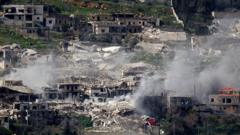
Israel Launches Full-Scale Invasion of Lebanon Against Hezbollah Forces
Israel's ground invasion into Lebanon marks a dangerous escalation against Hezbollah, directly challenging Iranian influence in the region. This military action risks intensifying regional conflict amid rising tensions with Iran.
Israeli forces have launched a full-scale invasion into southern Lebanon, escalating military engagement against Hezbollah. Armored units and infantry are reportedly crossing the border, marking a significant shift in Israel's military strategy toward confronting Iranian-backed groups operating in Lebanon. This operation could involve thousands of troops and armored vehicles as Israel moves toward a more aggressive posture in its northern territories.
The tensions between Israel and Hezbollah have reached a boiling point following months of sporadic skirmishes and rocket exchanges, with Iran's support for Hezbollah emboldening the militant group. The longstanding animosity stems from numerous conflicts, notably the 2006 Lebanon War, which saw Hezbollah inflict substantial casualties on Israeli forces. The current buildup follows a series of provocative incidents along the border, heightened by Hezbollah's growing rocket arsenal and increasing Iranian military involvement.
This invasion signifies a pivotal moment as it directly threatens the balance of power in the Middle East. Israel is positioning itself to weaken Hezbollah significantly, not only as a military force but also as a regional actor reliant on Iranian support. Furthermore, the skirmish opens the door for a broader confrontation involving Iran, which has pledged to support its proxy forces in Lebanon, heightening the stakes for international security.
Key players include the Israeli Defense Forces (IDF) and Hezbollah, backed by the Iranian Revolutionary Guard Corps, which provides military training and supplies. Israel's objective is to eradicate Hezbollah's military capabilities, which pose a direct threat to Israeli borders and civilian areas. Conversely, Hezbollah, with an estimated 30,000 fighters and an extensive arsenal of missiles, seeks to assert dominance in the region and bolster its image as a defender against Israeli aggression.
Operational details reveal that Israel's ground forces are being supported by airstrikes, which have been targeting supply lines and Hezbollah positions just prior to the invasion. The IDF has mobilized approximately 20,000 troops and deployed advanced military equipment, including Merkava tanks and artillery units. The financial implications are also staggering, with Israel investing billions annually to counter threats from Lebanese soil and maintain its qualitative military edge.
The likely consequences of this military incursion could lead to substantial loss of life on both sides and could ignite further clashes with Iran or its militias operating within the region. Internationally, the United States and European allies may be pressured to intervene diplomatically or militarily, escalating global tensions as nations align with their regional partners.
This development echoes past invasions, notably Israel's operations during the 1982 Lebanon War, where military objectives shifted but resulted in complicated, drawn-out conflicts. Both Israel and Hezbollah have entrenched positions, suggesting that any existing strategies may yield limited success without significant, sustained engagement on the ground.
In the coming days, signals to monitor include Hezbollah's retaliatory actions and potential Iranian military movements in response to Israel’s aggression. The international community will also be keenly observing how far Israel escalates its military operations while weighing possible repercussions against Iranian interests in the region.