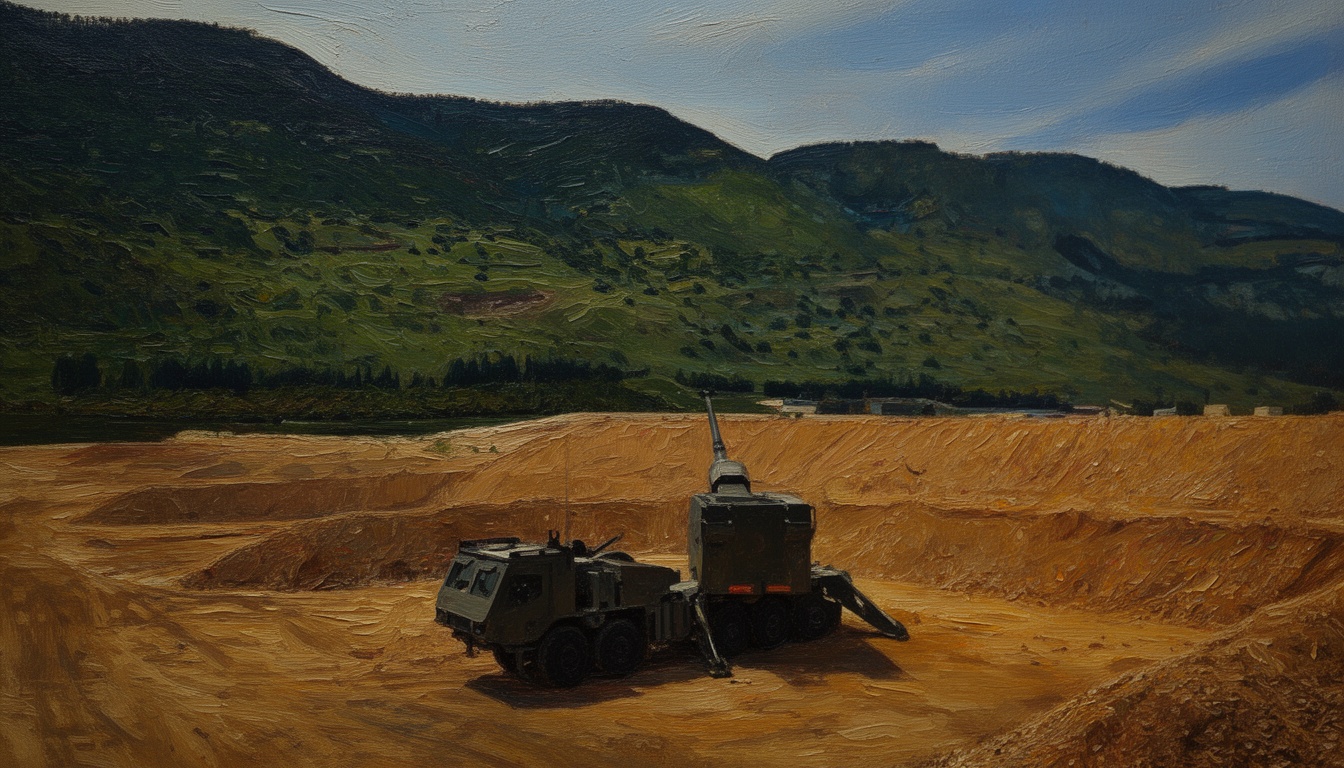
Israel Deploys Fully Automatic Roem Howitzer in Combat
Israel’s new autonomous Roem howitzer enters combat, delivering high-rate, long-range fire with limited crew. The development signals a push toward fully automated artillery in high-intensity conflicts. Analysts will watch for reliability, counter-battery, and deterrence implications across regional theaters.
In a dramatic combat debut, Israel has fielded its new fully automatic Roem howitzer, firing in actual hostilities for the first time. The system operates with an integrated automatic loading and fire-control suite, enabling sustained volleys at a claimed rate of 6-8 rounds per minute. Its maximum range is reported at 40 kilometers, allowing deep strikes beyond adversary artillery envelopes. The weapon’s first combat use marks a milestone in domestic artillery modernization and automation. Command and logistics personnel coordinated rapid deployment to the front, underscoring a prioritization of networked fires and near-real-time targeting data.
Background context situates the Roem within Israel’s broader push toward expeditionary, high-automation artillery. The platform complements existing towed and self-propelled guns by reducing crew exposure and increasing firing doctrine tempo. The move aligns with growing global trends toward unmanned and semi-autonomous fire control in high-intensity environments. Observers note that early deployment in combat could validate the system’s reliability under stress, while exposing potential vulnerabilities in supply chains, maintenance, and electronic warfare resilience.
Strategic significance centers on deterrence and force-multiplier effects. A fully automatic system with a 40 km reach tightens adversaries’ targeting constraints and complicates counter-battery campaigns. The Roem’s rapid-fire capability, when integrated with ISR, airspace control, and precision-guided munitions, enlarges the area denial envelope. This development could pressure regional rivals to accelerate countermeasure investments or adjust artillery dispersion patterns to complicate targeting. Critics will watch for how this affects arms race dynamics in the Eastern Mediterranean and surrounding theatres.
Technical and operational details remain cautiously framed. The Roem features an autonomous loading system, digitized fire-control, and compatibility with standard Israeli munitions. Crew requirements are reduced relative to traditional self-propelled guns, though technicians will still run diagnostics and handle ammunition logistics. Budget figures and procurement quantities have not been disclosed, but the fielding suggests a scalable approach to automated artillery across multiple battery configurations. Analysts anticipate continued upgrades in sensors, data links, and air defense integration to maximize survivability and accuracy.
Forward assessment points to two likely scenarios. First, a successful combat debut could drive broader adoption in regional arsenals, inspiring parallel automation programs. Second, as adversaries adapt with electronic warfare and hardening, the Roem’s resilience will depend on multi-layered cyber-physical protections and redundancy. The coming months will reveal how well this platform sustains volume-fire in contested environments and how it reshapes tactical decision cycles.