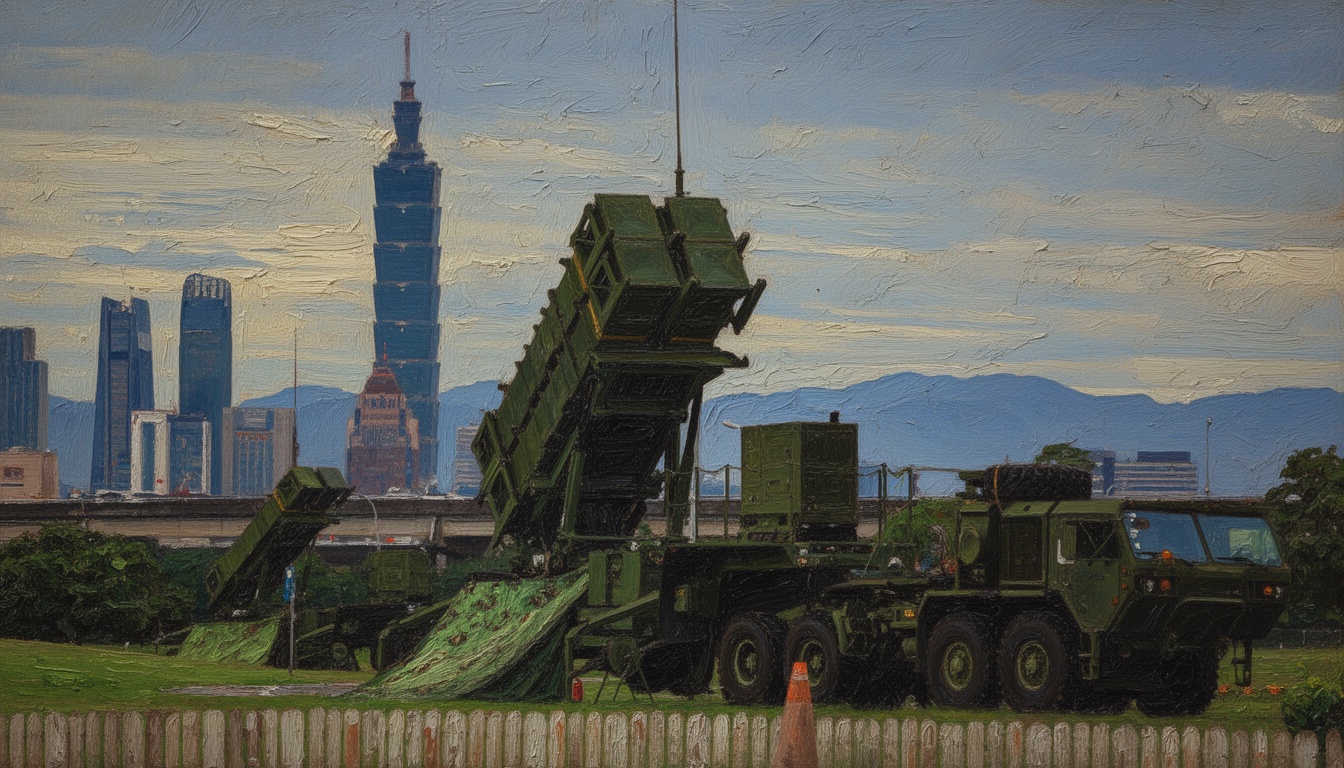
Iran's wartime resilience offers lessons for Taiwan
Iran’s sustained missile and drone strikes despite heavy external attacks has prompted Taiwan to reassess its defense posture. Officials warn resilience hinges on moving from a missile-centric shield to an integrated, survivable system. The debate underscores broader lessons for deterrence, resilience, and cost-effective defense in a high-tension Indo-Pacific balance.
Iran's wartime resilience offers a provocative blueprint for Taiwan as cross-strait hostilities loom. Tehran's ability to absorb and continue striking despite sustained US-Israeli pressure has prompted a rethink of how to deter, endure, and retaliate. The discussions in Taipei are sharpened by comparisons to Iran's drone and missile campaigns, and the question of whether air defenses alone can sustain a fight. The strategic takeaway is not a mirror image, but a warning: resilience will require systemic integration, not a fortress of missiles alone.
Background debates in Taiwan focus on a shift from a missile-dense defense to a more holistic architecture. Critics argue that while missiles can deter, they cannot guarantee survivability or reconstitution of a battle network after initial blows. Proponents counter that a layered approach—air, sea, cyberspace, and space—paired with redundancy, mobility, and resilience, can preserve command and control under duress. The Iran reference provides a concrete stress test for how long a defender can sustain a high-intensity trigger once the first strikes land.
Strategically, the Taiwan discussion centers on deterrence credibility and crisis management. If a conflict with the mainland escalates quickly, Taiwan would need rapid damage control, alternative basing, and resilient logistics to prevent paralysis. The Iran experience suggests that even with degraded air defenses, a state can continue operating if its force structure, targeting, and information systems can reconstitute to complicate an aggressor’s calculus. In short, resilience is as much about architecture and doctrine as it is about hardware.
Technical and operational details matter for planning. Taiwan’s forces would likely emphasize distributed air defense, mobile interceptors, and redundant command nodes, while seeking cost-effective platforms to complicate an attacker’s targeting. The analysis stresses integrated fires, cross-domain awareness, and robust cyberspace resilience to survive initial shocks. Budgets would need to fund risk-reducing upgrades, production lines for domestic systems, and international cooperation that hardens supply chains amid great-power competition.
Looking ahead, the implications are clear. A resilience-oriented Taiwan could deter escalation by complicating an adversary’s weapon-path and forcing longer timelines for any potential invasion. However, the path requires political buy-in, industrial acceleration, and credible endurance in the face of attrition. The strategic takeaway from Iran is not an exact playbook, but a warning: survival hinges on a survivable system that turns initial blows into strategic uncertainty for the attacker.