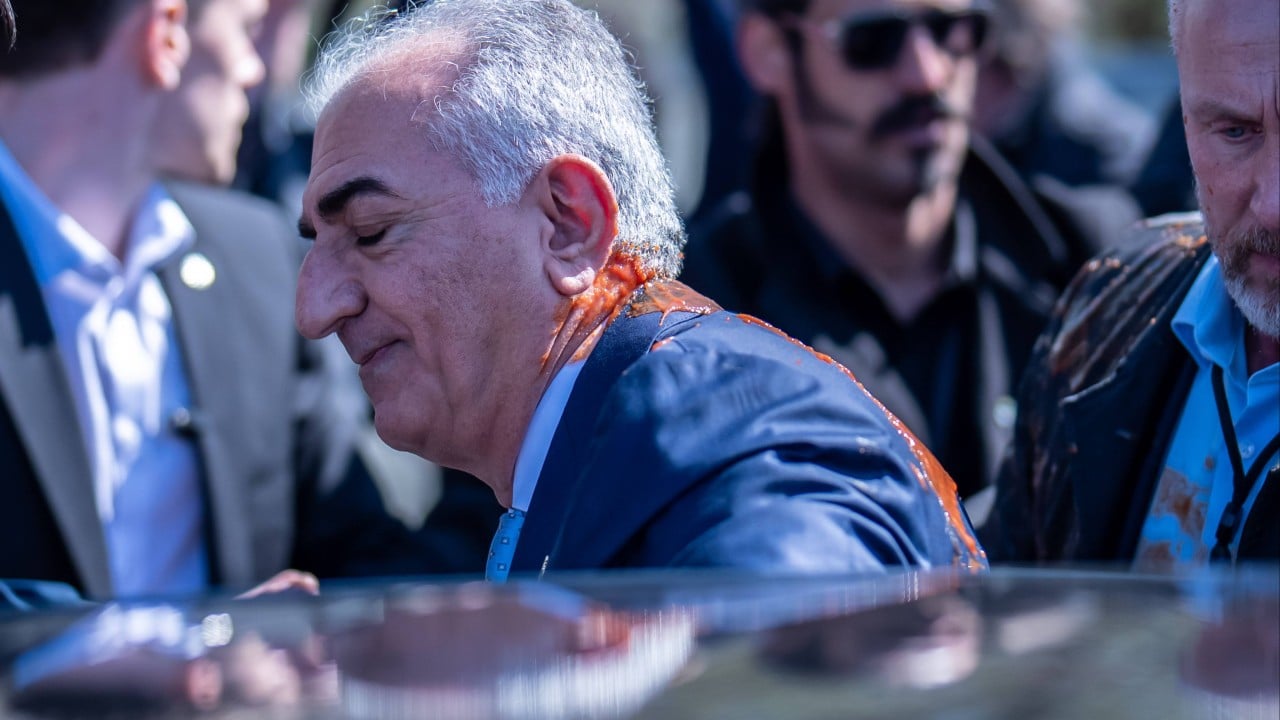
Iran's exiled crown prince Pahlavi splashed with red substance in Berlin
A high-profile political incident punctuates Berlin's public square as Reza Pahlavi, exiled crown prince of Iran, is splashed with red liquid outside the German federal press conference building. The event follows his critical remarks on the US-Iran ceasefire during a briefings session. Authorities are examining the motive and potential security gaps around a high-profile opposition figure in a foreign capital.
English content
A sharp, unexpected confrontation erupted as Reza Pahlavi, the exiled crown prince of Iran, was splashed with a red liquid while leaving a Berlin building. The incident occurred shortly after he had finished a news briefing, during which he criticized the ceasefire framework between the United States and Iran. The attack unfolded outside Germany's federal press conference building, drawing immediate attention from photographers, bystanders, and security personnel. He appeared unharmed, though visibly startled, and paused to acknowledge supporters before entering a vehicle that carried him away from the scene. Police described the liquid as a liquid coating that covered the back of his blazer and neck, with spectators reporting a mix of shock and anger in the immediate aftermath. Investigators have not publicly identified the assailants or the precise composition of the substance, and officials cautioned that early assessments may be inconclusive. In the hours after the incident, Berlin officials emphasized the need for a careful, lawful response while pledging to safeguard civil discourse around a sensitive regional issue. The attack adds a new layer of risk to the security environment surrounding Iranian opposition figures in exile and raises questions about the vulnerability of public-facing events in major European capitals. While no group immediately claimed responsibility, the incident will likely intensify debates about security protocols, venue arrangements, and the protection of political exiles abroad. Analysts emphasize that the broader dynamic—Iran's external political pressure, foreign capitals hosting opposition voices, and the fragility of public demonstrations—remains a critical fault line in regional security calculations. Berlin's police department announced that a full investigation is underway, including surveillance footage review, eyewitness interviews, and forensic analysis of the substance. Officials stressed that there will be a thorough review of event security, crowd management, and access control for high-profile figures who travel to Europe to speak on Iran's future. The international audience will watch closely to see whether this incident prompts tighter security measures around opposition leaders or prompts a debate about how host nations balance freedom of assembly with national security concerns. The broader implication is that political theater in European capitals can become a target for public acts of disruption, potentially altering how Iran-related rhetoric is delivered on foreign soil. As the investigation progresses, observers will track any statements from Pahlavi, his associates, or Iranian opposition groups that could signal a shift in strategy or risk appetite in response to the incident. The Berlin case may also influence how German authorities coordinate with European partners on protection for exiled leaders and on the boundaries of protest within official public spaces. The incident underscores the volatility surrounding Iran's diaspora politics and the challenges European cities face in maintaining open political discourse without inviting security compromises.
Background: Reza Pahlavi has been a prominent opposition figure among Iranians seeking reform and a transition away from the Islamic Republic's authority. His travels, gatherings, and statements often trigger reactions from Tehran and its international supporters, as well as from governments wary of destabilizing actions. Posts and statements from his camp frame his activities as peaceful advocacy, while opponents accuse him of undermining potential dialogue channels. In Berlin, the political atmosphere around Iranian exile voices is particularly tense given the city’s role as a hub for international diplomacy and sanction-driven policy discussions. Public demonstrations involving Iranian exiles have historically drawn security attention due to the regime's vigilance and the potential for cross-border political signaling. Berlin authorities have faced prior incidents linked to political protests in public squares, prompting a continuous evaluation of threat levels around high-profile appearances. The current event in Berlin thus sits at the intersection of diaspora politics, symbolic acts of protest, and the broader struggle over Iran's future governance and international relations.
Strategic significance: While not a military confrontation, the incident has strategic resonance for Iran's external image and for European approaches to political asylum, security protocols, and crowd management at high-profile events. It highlights the ongoing risk landscape facing exiled Iranian leaders in foreign capitals and could influence how European countries calibrate protections for political actors associated with contested national narratives. For European policymakers, the episode underscores the need to balance safeguarding free assembly with preventing disruptive acts that can escalate tensions around sensitive diplomacy. The event also comes amid broader debates about how Western diplomacy engages with Iranian opposition forces and the risk that external feuds could spill into public spaces. Observers will monitor if this act spurs any formal cross-border security advisories or changes in venue selection for future appearances by exile leaders. The incident therefore contributes to the evolving security calculus facing diaspora politics in Europe and may affect how host nations coordinate intelligence-sharing and protective measures for high-risk figures.
Technical/operational details: At present, the public detail available centers on the identity of the liquid, the precise motive, and the security protocols at the Berlin venue. Police have not disclosed the perpetrator's affiliation or whether the incident involved an accomplice, weaponized substances, or a broader plan. The analytic emphasis is on the security architecture of the event—entry screening, stewarded access, and the spacing between the public and the podium—and how a single disruptive act can test those layers. Investigators will likely examine CCTV coverage, responder timelines, and the chain of custody for any forensic material recovered at the scene. While the physical injury appears minimal, the longer-term security implications include potential revamps to public-appearance procedures for exiled political figures and more robust coordination with international partners regarding travel risk assessments. The broader operational takeaway for European event security is a reminder that protests can target symbolic leaders and that rapid-response protocols must be adaptable to evolving threat cues.
Likely consequences and forward assessment: In the near term, Berlin authorities will review venue design, access control, and contingencies for high-profile visitors. International observers may call for clearer guidelines on the protection of exiled leaders in foreign capitals, potentially leading to new bilateral or multilateral security arrangements. The episode could spur discussions about the visibility of opposition figures in European political life, and whether such visibility helps or hinders dialogue on Iran policy in Western capitals. Practically, event organizers might deploy stronger perimeter controls, more discreet protective details, and enhanced coordination with intelligence-sharing channels, all aimed at reducing disruption while preserving civil liberties. In the longer arc, this incident could influence how European capitals balance the presence of Iranian opposition personalities with the sensitivities of Tehran’s strategic calculations, potentially affecting the tempo of public engagements and the risk calculus surrounding diaspora diplomacy.
isGloballySignificant: false