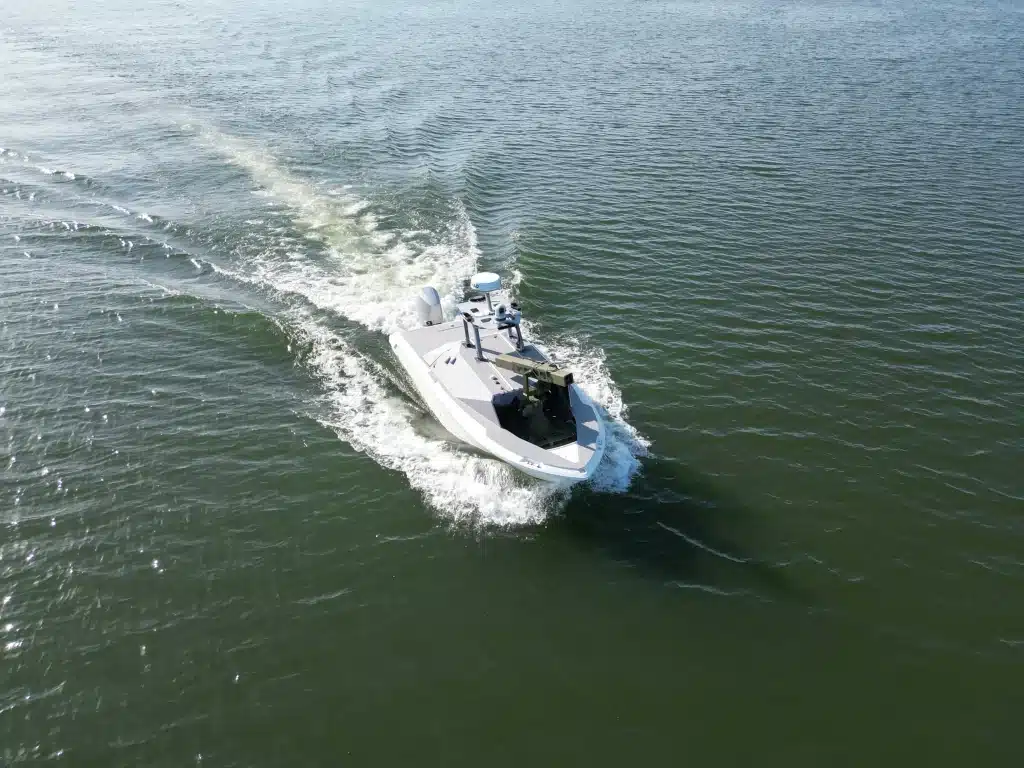
Invariant Demonstrates Counter-Drone Capability from USV
Invariant Corporation claims a milestone in autonomous maritime defense with its STAKE system mounted on a Textron TSUNAMI USV. The integration and early tests at Lake Guntersville indicate progress in surface-to-air kinetic engagement against unmanned aerial threats. Strategic implications center on distributed unmanned defense in littoral environments.
Invariant Corporation has publicly announced a successful demonstration of its Surface-to-Air Kinetic Engagement (STAKE) system, deployed on a Textron Systems TSUNAMI unmanned surface vessel (USV). The test reportedly integrated STAKE onto the USV and conducted early integration testing at Lake Guntersville. The company frames this as a significant advancement in autonomous maritime counter unmanned systems (C-UxS) capabilities. While details remain limited, the milestone suggests progress toward autonomous, shoot-though-air defenses at sea.
Background context for this development includes a growing emphasis on distributed sensor and shooter systems in maritime security. USV platforms are increasingly leveraged to extend littoral reach, reduce human exposure, and complicate adversaries’ targeting. Invariant’s approach with STAKE combines kinetic counter-drone engagement with autonomous control, potentially reducing response times for aerial threats over complex coastal and harbor environments. The Lake Guntersville test area provides a controlled setting to validate system integration before broader field trials.
Strategically, success for STAKE on a USV signals a shift toward networked, autonomous kill chains that could operate with limited human-in-the-loop decision making. The capability would complement existing air defense architectures by adding a mobile, hard-to-suppress platform capable of engaging small, low-altitude drones that threaten ships, ports, and critical maritime assets. The development feeds into broader trends of distributed lethality and sea-denial options for navies and defense ministries facing inexpensive, proliferating unmanned aerial systems.
Technical details released are sparse, but the arrangement involves the STAKE weapon system integrated onto a TSUNAMI USV, with tests emphasizing early interoperability and real-time engagement sequences. Specifications such as engagement range, interceptor type, magazine capacity, and power requirements have not been disclosed in the public brief. Observers will look for follow-on trials that demonstrate multi-target tracking, sustained engagement cycles, and resilient control in contested electromagnetic environments.
Likely consequences include acceleration of toward-networked unmanned defense suites for maritime security, potential collaborations between unmanned surface platforms and airborne or space-based sensors, and a push to refine mission-planning software for rapid, autonomous decision-making. Analysts will monitor for additional disclosures on performance metrics, system hardening, and integration with existing naval air defense layers. If successful, this pathway could influence procurement decisions and force design in littoral navies seeking scalable, modular C-UxS capabilities.