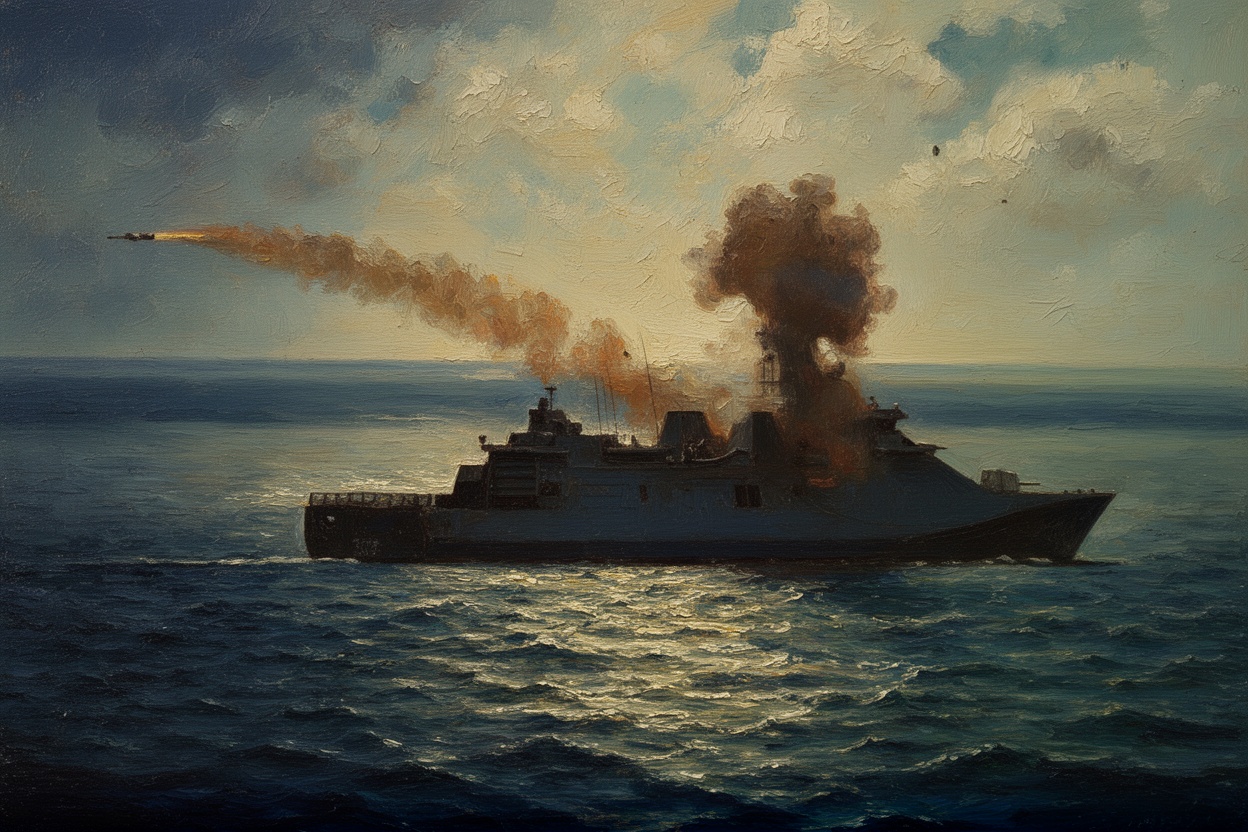
Indonesia Reaffirms Aegis-like SINKEX Capabilities with Java Sea Live-Fire Sink
Indonesia conducts a large-scale combat exercise in the Java Sea featuring a SINKEX against a decommissioned LST. The drill blends naval and air assets in a visible show of maritime firing and target-tuning. This marks the first SINKEX since mid-2024, underscoring Jakarta’s ongoing emphasis on training realism and fleet kill-chain robustness.
Indonesia staged a large-scale maritime exercise in the Java Sea that included a sinking exercise (SINKEX) as a centerpiece of a broader live-fire drill involving coordinated naval and air assets. The operation served as a tangible test of the Indonesian Navy’s (TNI AL) ability to prosecute a surface target under combat conditions, and it highlighted the service’s emphasis on realism and training fidelity. The exercise appears to have integrated electronic warfare, precision gunnery, and air-delivered munitions in a combined-arms profile designed to sharpen response times and target discrimination under pressure. This event represents a public demonstration of capability development and readiness in a region where maritime competition and sea-denial countermeasures are increasingly prioritized.
Background context indicates that SINKEX events are relatively rare but strategically valued for validating target lethality, weapon performance, and sensor-to-shooter integration. The Java Sea, a chokepoint for regional shipping and a nexus of Indonesian maritime activity, provides a demanding testing ground for damage control, survivability parameters, and after-action learning. The decommissioned Frosch-class landing ship tank (LST) selected as the target underscores a broader tendency to repurpose aging hulls as cost-effective training platforms while extracting actionable data on hull behavior, buoyancy thresholds, and explosive effects. The specific vessel—designated as KRI Teluk—is identified as the stationary target, with the naming truncated in current summaries, but its role as a historical platform remains the focal point of the exercise.
Strategically, the drill reinforces Indonesia’s deterrence posture in a structurally congested maritime domain. By validating kill-chain integration across sea and air domains, Jakarta signals to potential adversaries the operational tempo and methodological rigor of its surface fleet. The SINKEX also serves as a physical reminder of the navy’s capability to adapt legacy platforms into live-fire training assets, potentially informing future platform retirement decisions and hull-level survivability analyses. In a broader sense, the exercise contributes to regional understanding of how Southeast Asian navies maintain readiness against evolving anti-access/area-denial environments and amphibious threats.
Technical and operational details emphasize the complexity of the engagement. The exercise combined surface warfare combat elements with air sorties to simulate real-world encounter conditions, employing coordinated targeting, trajectory corrections, and safety protocols for live munitions. While specific weapon designations and platform types are not exhaustively disclosed, the event likely tested a spectrum of ordnance and support systems—from gunfire to air-delivered munitions—against a decommissioned hull to observe blast effects, hull rupture progression, and debris dispersion. The presence of a SINKEX in a live-fire drill also implies robust command-and-control handoffs, targeting prioritization under variable sea states, and real-time data collection for performance assessment.
Looking ahead, the implications for Indonesian naval modernization are twofold. First, the exercise provides empirical data to calibrate training curricula, sensor fusion, and damage-control protocols, potentially shaping future fleet-air defense integration and amphibious-warfare planning. Second, the public demonstration of sinking a legacy hull can influence regional perceptions of Jakarta’s willingness to invest in realistic training theaters and to push for tighter interoperability with allied partners. For observers, the event flags a continued emphasis on practical lethality and rapid adaptation, suggesting that Indonesia intends to sustain a credible forward-leaning posture in the Indo-Pacific maritime balance.