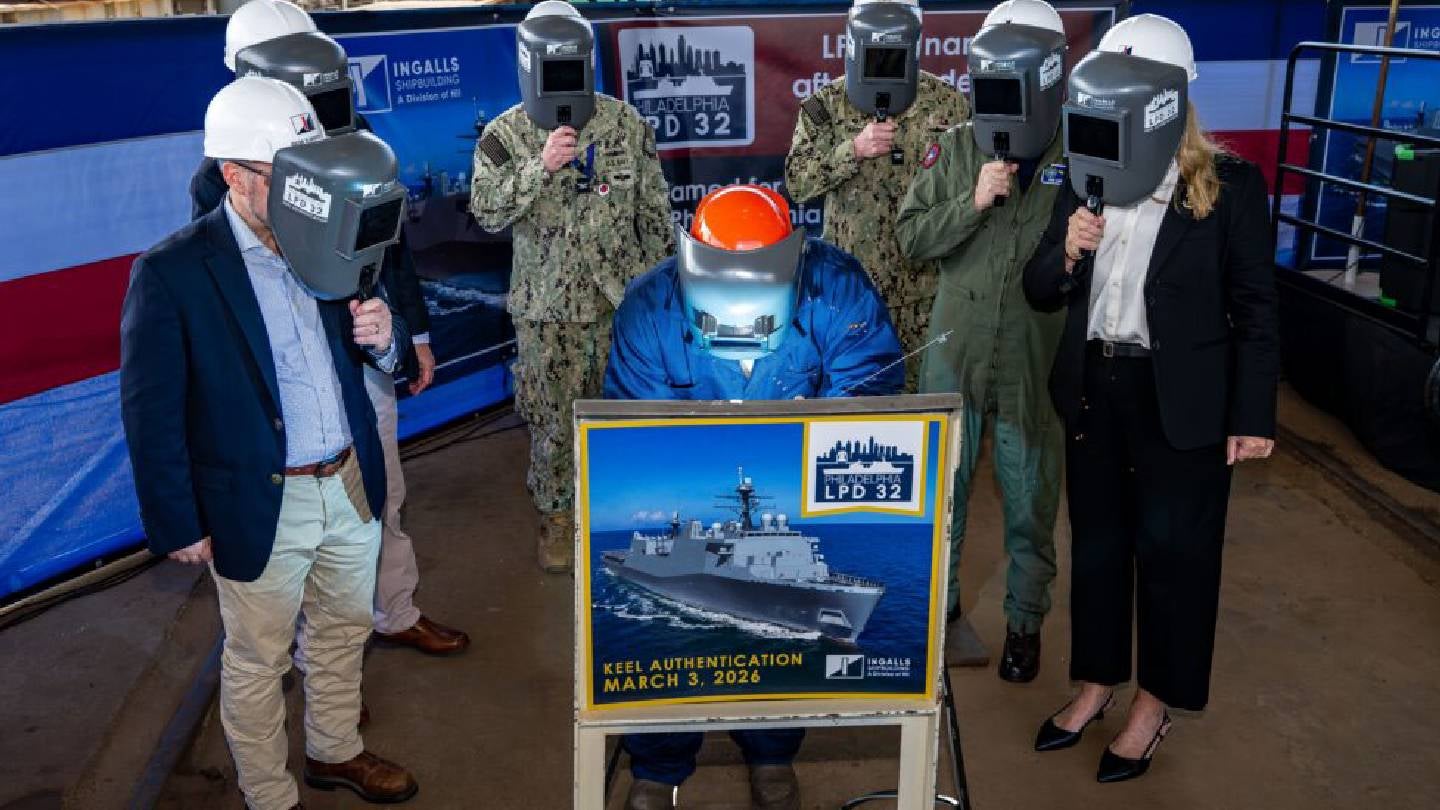
HII Commences Construction of USS Philadelphia Amid Rising Naval Threats
The keel laying of the USS Philadelphia unveils critical U.S. naval expansion plans as geopolitical tensions intensify. This Flight II San Antonio-class vessel is set to enhance U.S. amphibious capabilities at a time when power dynamics shift worldwide.
Huntington Ingalls Industries (HII) has officially laid the keel for the future USS Philadelphia, a Flight II San Antonio-class amphibious transport dock ship, at their Ingalls Shipbuilding facility. This move marks a significant escalation in the U.S. naval shipbuilding program, emphasizing a rapid military buildup amid increasing global maritime threats. The USS Philadelphia will serve as a critical asset in enhancing the U.S. Navy’s amphibious warfare capabilities and strategic reach.
This announcement follows a series of evolving threats in key maritime environments. Tensions between major powers, especially in the Indo-Pacific region, have necessitated a rethink of naval strategy and capabilities. The Flight II San Antonio-class is designed to support amphibious operations, allowing for the effective deployment of Marines and their equipment, which is vital in potential future conflicts. The prioritization of such vessels poises the U.S. to respond more decisively to regional crises.
The significance of this development cannot be overstated. The U.S. Navy is navigating a turbulent security landscape with rising maritime threats from nations such as China and Russia. The construction of the USS Philadelphia signals a commitment to countering adversarial influences and maintains the United States’ naval superiority. The presence of advanced amphibious vessels enhances the ability to project power and conduct humanitarian missions, but also raises the stakes in potential confrontations with rival forces.
Key players in this scenario include the U.S. Navy and its defense contractors, along with adversarial nations that closely monitor such advancements. The U.S. aims to assert its dominance through naval presence, while adversaries like China are likely interpreting this build-up as a provocation, responding with their own military enhancements and strategic postures. The motivations are clear: the U.S. seeks to fortify its influence, while adversaries aim to challenge it.
The USS Philadelphia will be equipped with state-of-the-art technologies that enhance its operational capabilities. These include advanced communications systems, the ability to carry MV-22 Ospreys and CH-53K helicopters, and a well deck for launching landing craft. The financial commitment to this project showcases the U.S.’s focus on maintaining robust amphibious forces, with costs running into the billions for modernized fleets.
In terms of potential fallout, the commissioning of the USS Philadelphia will likely escalate naval drills and military posturing from rival powers that feel threatened by U.S. actions. Enhanced deterrence posture may provoke an arms race at sea, as other nations may bolster their own amphibious and naval capabilities in response. The operational calculus of conflicts may shift as these vessels enable far-reaching engagements in potential future theaters of war.
Historically, new ship classes always incite reactions from other maritime powers. The increased emphasis on amphibious and expeditionary warfare mirrors actions from the Cold War era, where naval shipbuilding was often matched by fleets from the Soviet Union. The construction of the USS Philadelphia may spark similar competitive shipbuilding efforts, underlining the cyclical nature of maritime power dynamics.
Looking ahead, analysts and military planners must monitor the U.S. Navy’s future commissioning timelines and the strategic deployments of the USS Philadelphia. Key indicators include future naval exercises, responses from major power naval fleets, and shifts in defense budgets. Observing how adversaries adjust their strategies in light of this new capability will be crucial for understanding the implications for international security as tensions continue to rise in strategic regions.