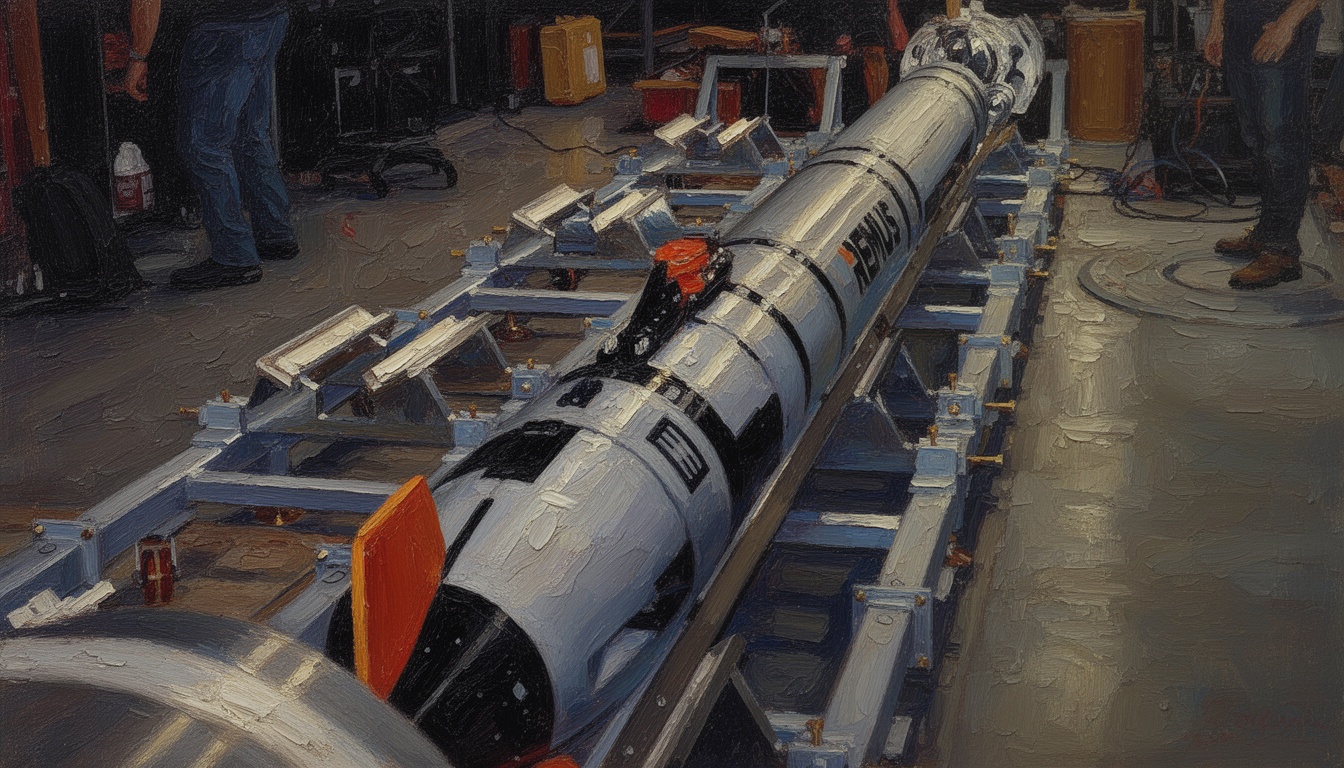
HII Builds on Submarine MUM-T Success with New Pentagon Deal
A Pentagon DIU contract funds a TTLR system to autonomously deploy and recover REMUS unmanned underwater vehicles from U.S. Navy submarines. The development advances submarine manned-unmanned teaming (MUM-T) capabilities and expands enduringyti maritime unmanned operations. The program signals continued push to extend sensor and access reach below the surface with limited crew risk.
The core development is blunt and concrete: Huntington Ingalls Industries receives a DIU award to deliver a Torpedo Tube Launch and Recovery system that autonomously deploys and retrieves REMUS UUVs from submarines. This sits squarely in the domain of submarine-enabled autonomous mission management and unmanned maritime systems integration. The contract builds on prior MUM-T work, aiming to increase surface-to-subsurface collaboration without expanding submarine crew loads. The emphasis is on reducing human exposure while expanding persistent presence underwater.
Background context shows that the U.S. has long pursued integrated manned and unmanned operations to extend the reach of subsurface platforms. REMUS-type UUVs have been a mainstay in littoral reconnaissance, mine countermeasures, and environmental sensing, often deployed from ships or fixed stations. The DIU focus reflects a broader shift toward modular, swappable unmanned assets that can be brought into submarines’ ocean-facing duty cycles with minimal human intervention. This upgrade aligns with ongoing modernization of maritime ISR and undersea warfare competencies.
Strategic significance centers on the potential to dramatically increase mission endurance and versatility without increasing submarine patrol timelines. An autonomous TTLR reduces the need for surface handling and complex dive-and-retrieve operations, improving survivability and tempo in contested environments. It also enhances the ability to stage rapid UUV-based reconnaissance, hydrographic sampling, and predefined engagement or mitigation tasks in high-threat zones. The development integrates with broader Navy goals of distributed sensing and reach, complicating adversaries’ anti-access strategies.
Technical or operational details remain high-level in public descriptions: the TTLR is designed to interface with submarine launch tubes and automatically handle REMUS payloads, enabling quick insertion and recovery cycles. The system will require robust undersea data links, fault-tolerant control software, and rugged mechanical interfaces to withstand undersea pressures and cyclic loading. Budget figures and exact subsystem specifications are not disclosed, but the effort sits within a broader push toward autonomous maritime systems and cross-domain integration.
Likely consequences and forward assessment point to a more capable submarine flotilla with greater ISR continuity and reduced crew workload in extended deterrence missions. If successful, the TTLR could become a standard fit for future attack and ballistic-melt submarines, enabling more frequent small-footprint UUV operations without exposing sailors to risk. The program will face challenges in reliability, safety certification, and interoperability with diverse UUV payloads, but its progression will shape future submarine force design and autonomy governance across allied fleets.