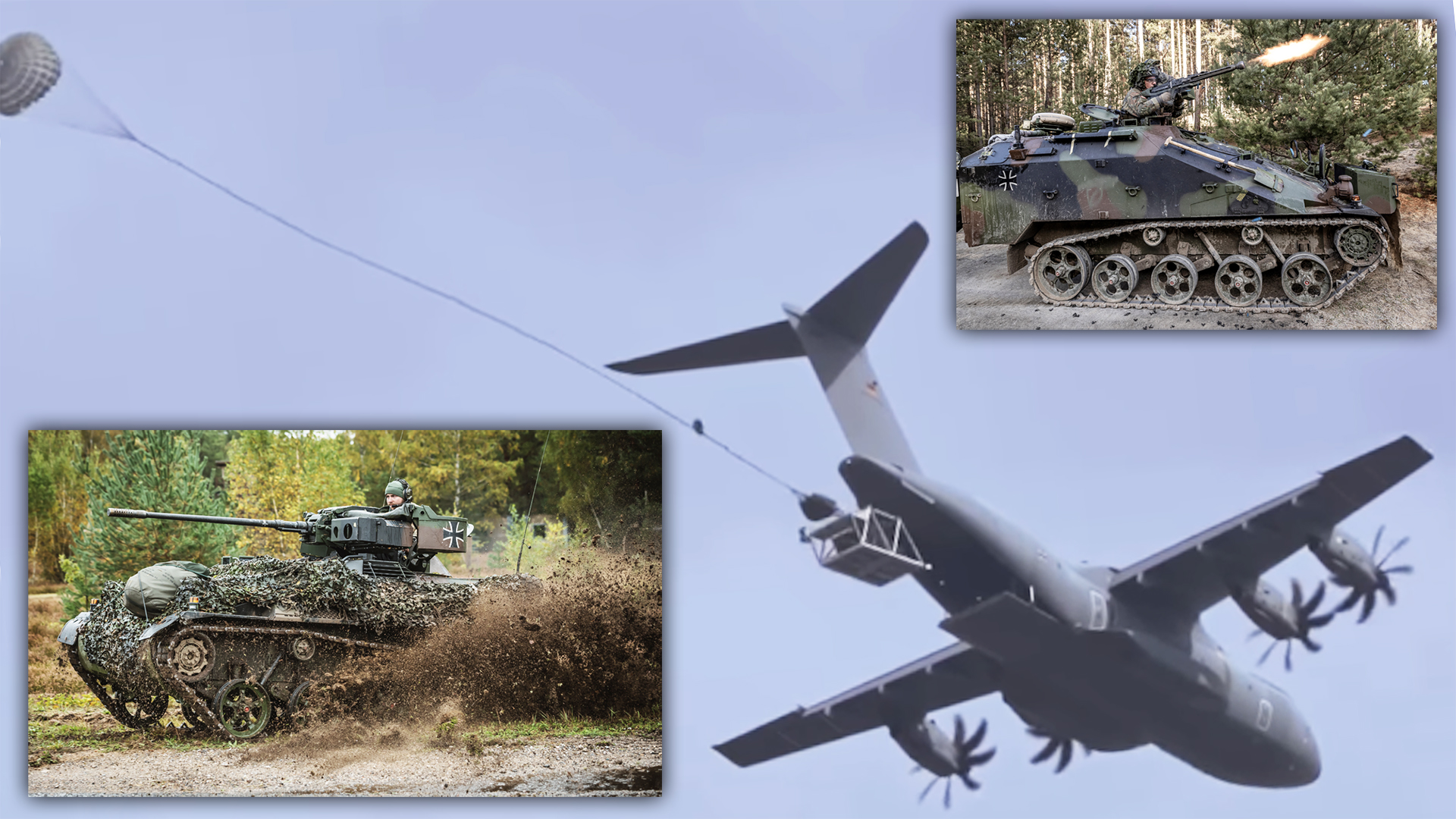
Germany Airdrops Wiesel Tankette: Small, Agile Firepower on the Move
Germany’s airborne forces begin airdropping the Wiesel light tankette from A400M transports. The move expands rapid forward firepower deployment for light armor units and demonstrates growing reliance on airborne-macroscale mobility. Strategic effects include enhanced tactical agility in contested environments and a lighter balance of maneuver and protection for rapid-reaction formations.
Germany’s airborne forces are adopting airdrop delivery for the Wiesel light armored platform using A400M transports, a step that accelerates the forward placement of firepower with minimal ground mobilization. The development underscores an ongoing push to maximize aerial acuity and rapid reach for light armor assets in high-threat zones. The Wiesel’s compact size and established air-transportability enable airborne units to project combat power quickly, even when airfields are limited or contested.
Background context shows the Wiesel lineage as a designed-for-light, fast-moving armor system. Built to operate in rugged and confined terrains, the vehicle has long complemented mobile infantry and airborne task forces. The ability to deploy via large military transport aircraft represents a natural evolution in how Germany’s airborne corps can sustain tempo and momentum when air superiority is degraded or logistics lines are stretched.
Strategic significance centers on the shift from ground-lift to air-lift for dedicated light armor. This capability strengthens tactical resilience by creating options for rapid penetration, flank protection, and emergency reinforcement in mountainous, urban, or austere settings. It also signals a broader doctrinal emphasis on adaptable, scalable fire support within the air-mechanized continuum, potentially influencing neighboring alliance planning and regional deterrence calculations.
Technical and operational details remain partial in public disclosures, but the basic framework involves the Wiesel being loaded into A400M cargo configurations or adapted drop systems for precise pickup and release. Expected metrics would include payload compatibility, airdrop stability, and quick-discharge procedures to minimize exposure windows during insertion. Budget and force structure figures are not publicly enumerated, but the development aligns with ongoing modernization trends in light armor for airborne formations.
Forward assessment indicates a probable boost to mission success rates for rapid assault, reconnaissance-in-force operations, and area-denial missions in challenging terrains. Expect continued refinement of air-drop tactics, including load limits, ingress routes, and contingency procedures for weather and hostile airspace. The trend also suggests potential further integration with unmanned systems and next-generation light armor variants to sustain a high tempo of operations.