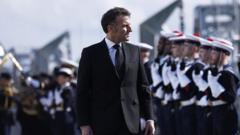
France Expands Nuclear Arsenal, Threatens Sole Control Over European Security
France's decision to enhance its nuclear capabilities and extend a deterrent umbrella to eight European nations underscores a significant shift in European military strategy and power dynamics. This move raises concerns over centralized decision-making in a region increasingly vulnerable to external threats.
France has announced plans to bolster its nuclear arsenal, aiming to enhance deterrence capabilities amid rising regional threats. President Emmanuel Macron revealed that France's nuclear umbrella will now potentially cover eight European nations, allowing them to seek protection under Paris' nuclear capabilities. However, Macron made it clear that France will retain unilateral control over any nuclear response, raising questions about collective security in the region.
This development is rooted in the deteriorating security environment Europe has faced in recent years. Heightened tensions with Russia, particularly following the invasion of Ukraine, have prompted European nations to reconsider their defense strategies. Countries like Poland and the Baltic states, which feel exposed to potential aggression, are increasingly seeking security guarantees. France's move represents a pivotal shift in its defense posture, moving from a purely national framework to a more regional approach to deterrence.
The significance of France's nuclear expansion cannot be understated. This is not only about military capability but also reflects a strategic pivot towards more assertive regional defense policies. The centralized decision-making required by Paris raises fears of delayed responses in crises that could jeopardize European security. Such consolidation of power amidst multiple states seeking protection may lead to tensions over national sovereignty and decision-making authority within NATO and the European Union.
Key actors in this evolving landscape include France, which seeks to position itself as a regional security leader, and various Eastern European nations keen on bolstering their defenses. Macron's motivations seem to stem from a desire to project power and influence within Europe while meeting the security needs of countries anxious about Russian expansionism. However, the unilateral nature of France's decision-making could alienate some allies who may desire a more collaborative security framework.
Operationally, France is expected to increase its nuclear warhead count, currently estimated at around 290 warheads. This expansion comes with financial implications, as investment in nuclear capabilities will demand significant budget allocations. France is also likely to enhance the survivability of its submarine fleet, which plays a crucial role in second-strike deterrent capabilities against adversaries, thereby escalating the arms race within Europe.
The likely consequences of this escalation are multi-fold: it may provoke neighboring countries to pursue their own nuclear capabilities or enhance existing partnerships with the United States and the United Kingdom. Additionally, centralizing nuclear decisions may result in longer response times during crises, increasing the risk of miscalculations. The perceived need for self-defense could also lead to arms races fueled by fear rather than strategic stability.
Historically, France's nuclear ambitions have resonated with earlier periods of tension, such as during the Cold War when nuclear deterrence shaped European security strategies. The current developments evoke memories of security dilemmas that intensified arms races between superpowers, where decisions made in Paris could potentially destabilize the entire region.
Moving forward, monitoring international reactions to France's nuclear expansion will be crucial. Key intelligence indicators include the responses from NATO allies, especially in Eastern Europe, as well as shifts in defense budgets across European nations. In particular, ongoing discussions about collective defense within NATO may provide insights into how European powers will adapt to France's growing nuclear influence and what implications this will bear for the continent's security architecture.