Exiled Kurdish Fighters Face Iranian Drone Attacks in High-Stakes Standoff
Iran's drone strikes against exiled Kurdish fighters signal escalating tensions and a potential confrontation. The fighters, poised to return to Iran, face imminent threats from Tehran's military might.
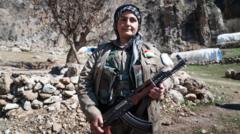
A group of exiled Kurdish fighters in Iraq currently faces lethal drone strikes from the Iranian regime, dramatically escalating tensions between Tehran and Kurdish factions. These attacks come amid heightened threats from Iran, prompting the Kurdish fighters to declare they are 'ready to go home' and confront the encroaching danger head-on. The situation is quickly evolving into a crisis as Iranian drones target the fighters' positions in Iraq, putting lives at risk and provoking strategic dilemmas for both sides involved.
Historically, tensions between Iran and Kurdish groups like the Kurdistan Workers' Party (PKK) have been fraught with conflict dating back decades. Following the 1979 Iranian Revolution, the Kurdish population within Iran has faced brutal repression, while Iran has engaged in a long-standing campaign against separatist groups. The Kurdish fighters, based in Iraq's semi-autonomous Kurdistan region, have gained military experience in recent years due to their involvement in combating ISIS, positioning them as a significant threat to Tehran's control over the region.
The significance of the ongoing drone strikes cannot be overstated. Iran’s capability to project power with precision strikes raises alarm over the vulnerabilities of Kurdish forces, potentially shifting the balance of power in Iraq and the broader Middle East. Should the attacks continue and lead to substantial casualties among Kurdish fighters, it may incite a larger conflict, drawing in external actors and complicating regional security dynamics.
The key players in this confrontation include Iran, which seeks to maintain its regional dominance, and Kurdish factions that are more emboldened than ever following their successes against ISIS. Iranian officials are likely viewing the exiled fighters as a destabilizing force that must be eliminated. Conversely, the Kurdish groups are driven by a mix of nationalism and a desire for autonomy from Tehran's repression, seeing this moment as a chance to reclaim territory and assert their influence in Iranian Kurdistan.
From a technical perspective, Iran’s drone strikes utilize Shahed-series unmanned aerial vehicles (UAVs), designed for precision targeting of ground forces and infrastructure. These drones have been extensively employed to great effect by Iranian forces in past conflicts. Simultaneously, the exiled Kurdish fighters potentially possess Soviet-era weaponry and small arms, but lack the advanced air defense systems necessary to counter drone surveillance and strikes, putting them at an extreme disadvantage.
If the current crisis escalates further, it is likely that we could see a notable increase in Iraqi military involvement or even external support for the Kurdish fighters, complicating Iran's military calculations. Potential Iranian losses could redefine their approach to Kurdish insurgents, possibly prompting more aggressive military campaigns. Furthermore, an increase in unrest could prompt the international community to respond or intervene to stabilize the situation.
Historical parallels can be drawn to the U.S. support for Syrian Kurds during their conflict with ISIS and Turkish-backed forces. The situation exemplifies how regional dynamics can shift drastically based on international involvement and support. Similarly, the Kurdish fighters' struggle against Iranian forces may inspire greater international attention, especially from Western nations wary of Iran’s growing regional ambitions.
Looking forward, intelligence analysts will monitor Iranian military operations closely and any indications of potential Kurdish military buildups. Key signs to watch will include rising rhetoric from Iranian officials regarding the threats posed by Kurdish groups, and any further military escalations such as additional drone strikes or ground troop mobilizations within the region. The unfolding situation in Iraq's Kurdistan may well have ramifications that extend far beyond the immediate actors involved, potentially igniting broader regional conflicts.