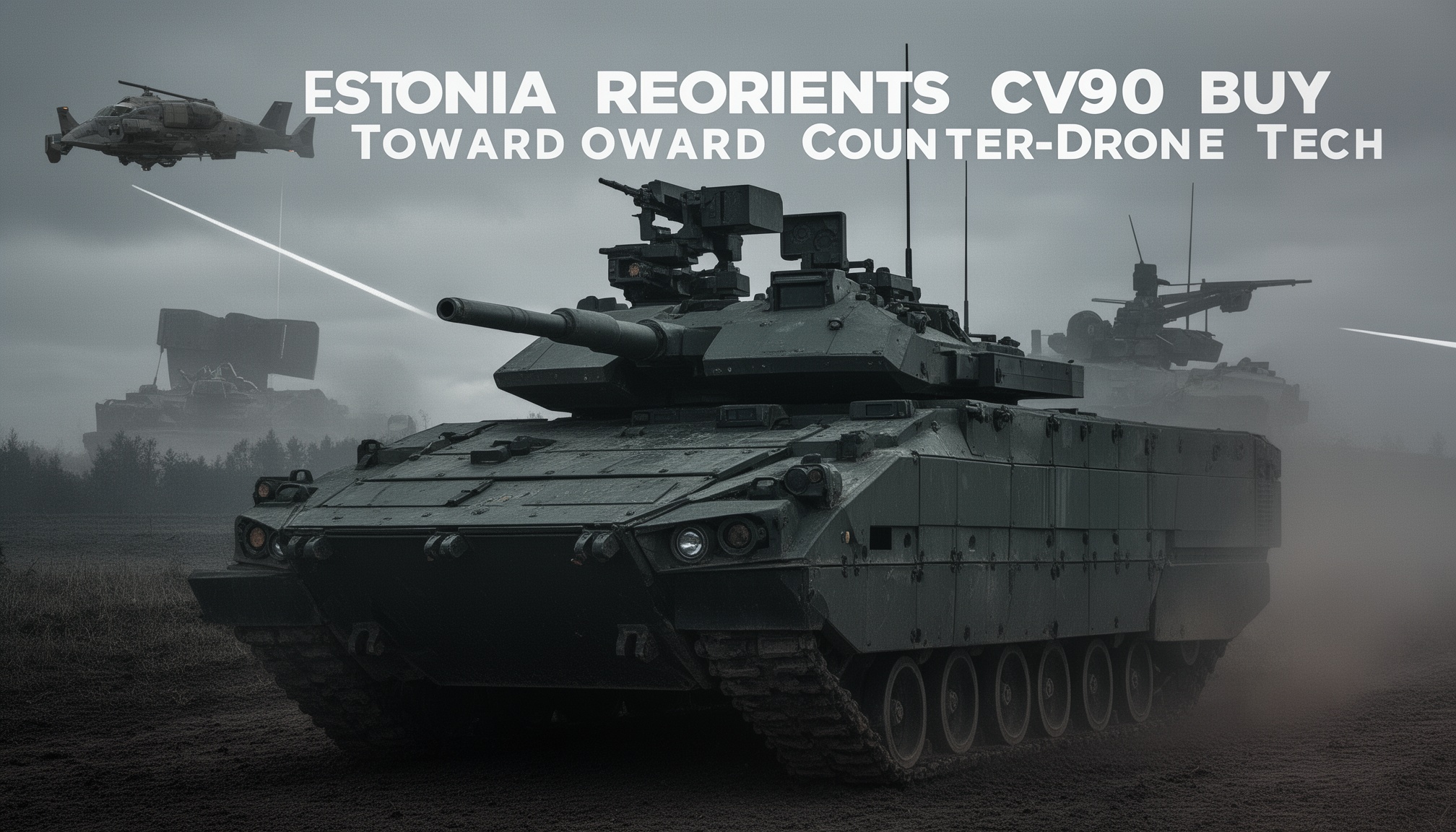
Estonia Reorients CV90 Buy Toward Counter-Drone Tech
Estonia redirects defence funds from CV90 infantry fighting vehicle purchases to counter-drone capabilities. The move signals a sharpened emphasis on urban and dispersed combat risk, with deterrence built around air-and-space-enabled ISR and kinetic counter-drone systems. It reflects wider Baltic-security concerns as near-peer pressure grows and drone threats evolve.
Estonia has announced a strategic reallocation of its defence budget, shifting away from a planned CV90 infantry fighting vehicle procurement to invest in counter-drone capabilities. The decision follows an assessment that unmanned aerial threats pose a greater disruption risk to mobile formations and logistics in Baltic airspace and contested corridors. Tallinn cites the need to harden dispersed formations and improve situational awareness across the battlefield as central to its reform agenda.
The background to this pivot lies in Estonia’s long-standing emphasis on resilience, rapid response, and interoperability with NATO allies. Baltic states have consistently argued that large, conventional wheeled IFVs must be balanced with lighter, more deployable assets capable of fending off drones and loitering munitions. The shift also dovetails with Finland’s and Latvia’s defence planning trends, which increasingly weigh anti-drone modules and air-defence integration alongside traditional mechanized programs.
Strategically, the move expands Estonia’s deterrence envelope at a time of rising drone proliferation and possible swarming tactics by adversaries. It reinforces a layered defense concept that links intelligence, surveillance, target acquisition, and electronic warfare with kinetic counter-drone effects. The plan also signals soft power: it pressures allied suppliers to accelerate modular weaponry, sensors, and interoperability upgrades that can be shared across the NATO perimeter.
Technical and operational specifics revolve around a redefined budget line for counter-drone systems, including sensors, effectors, and command-and-control networks. Estimates indicate investment in lightweight, mobile anti-drone platforms, RF jammers, direction-finding gear, and high-altitude ISR capabilities designed to integrate with existing CV90 baselining where relevant. The precise allocation remains provisional, but officials emphasize faster procurement cycles and joint testing with allied industry.
Looking ahead, Tallinn faces questions about how this pivot will influence alliance logistics, regional deterrence credibility, and industrial partnerships. The shift could accelerate NATO’s emphasis on electromagnetic warfare and drone countermeasures in the Baltic corridor. If successful, the move may compel neighboring states to reframe their own infantry vehicle programs around more flexible, drone-resilient architectures.