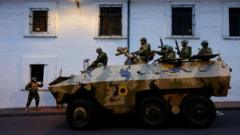
US-Ecuador Military Operation Targets Terrorist Drug Traffickers
The US and Ecuador's joint military operation reveals deepening collaboration against organized crime linked to terrorism, heightening security threats in the region. This escalation signals a commitment to countering transnational criminal networks that undermine state authority and stability.
The United States and Ecuadorian forces have launched a military operation aimed at disrupting organized crime networks identified as designated terrorist organizations operating within Ecuador. This operation represents a significant escalation in efforts to combat drug trafficking, with US military assistance actively involved in the fight against these groups, which Washington links to broader destabilizing forces within South America.
This move follows years of escalating violence and insecurity in Ecuador, marked by increasing assassinations, prison riots, and drug-related crime that have drawn the attention of both the US government and Ecuadorian officials. In recent months, the country has seen a staggering rise in murders attributed to drug trafficking organizations vying for control of lucrative narcotics routes, culminating in public outcry and demands for stronger actions against these threats.
The significance of this operation extends far beyond the immediate commitment of military assets. It indicates a potential shift in US foreign policy, prioritizing counter-narcotics and security cooperation in response to rising instability. South America’s cocaine production capabilities have surged, with Ecuador positioned as a key transit hub, exposing vulnerabilities and testing regional stability as neighboring countries also face similar threats.
Key actors in this operation include the Ecuadorian government under President Daniel Noboa, who seeks to enhance national security credibility, and the Biden administration, which is prioritizing regional stability. For the US, supporting Ecuador’s fight against terror-linked drug trafficking not only aims to curb narcotics but also presents an opportunity to counter Chinese influence in the region as drug trafficking networks often have transnational ties, complicating international security dynamics.
Operationally, the US has mobilized assets under the Southern Command framework, which may include surveillance drones, special operations units, and intelligence-sharing programs. Ecuador, with recent defense budget increases, is likely leveraging air and naval capabilities, including its Embraer EMB 314 Super Tucano aircraft, equipped for advanced reconnaissance and interdiction operations against drug traffickers.
The implications of this escalated military collaboration are profound, potentially leading to a reinforced military presence in the region. As the operation progresses, a range of escalation vectors could arise, from increased violence from criminal groups retaliating against military actions to possible broader US military involvement in regional security operations.
Historically, military cooperation in counter-narcotics and terrorism has faced challenges in Latin America, drawing parallels to past US interventions in Colombia and Mexico. Yet, unlike those precedents, Ecuador's internal dynamics and the resurgence of organized crime may complicate the effectiveness and sustainability of such engagements, raising questions about long-term strategies.
Moving forward, intelligence indicators to watch include shifts in drug trafficking routes, changes in violence patterns, and the Ecuadorian government's internal political stability as it navigates this dangerous and complex terrain. The outcomes of this operation may not only shape Ecuador's immediate security landscape but also influence broader regional alliances and counter-narcotics strategies across South America.