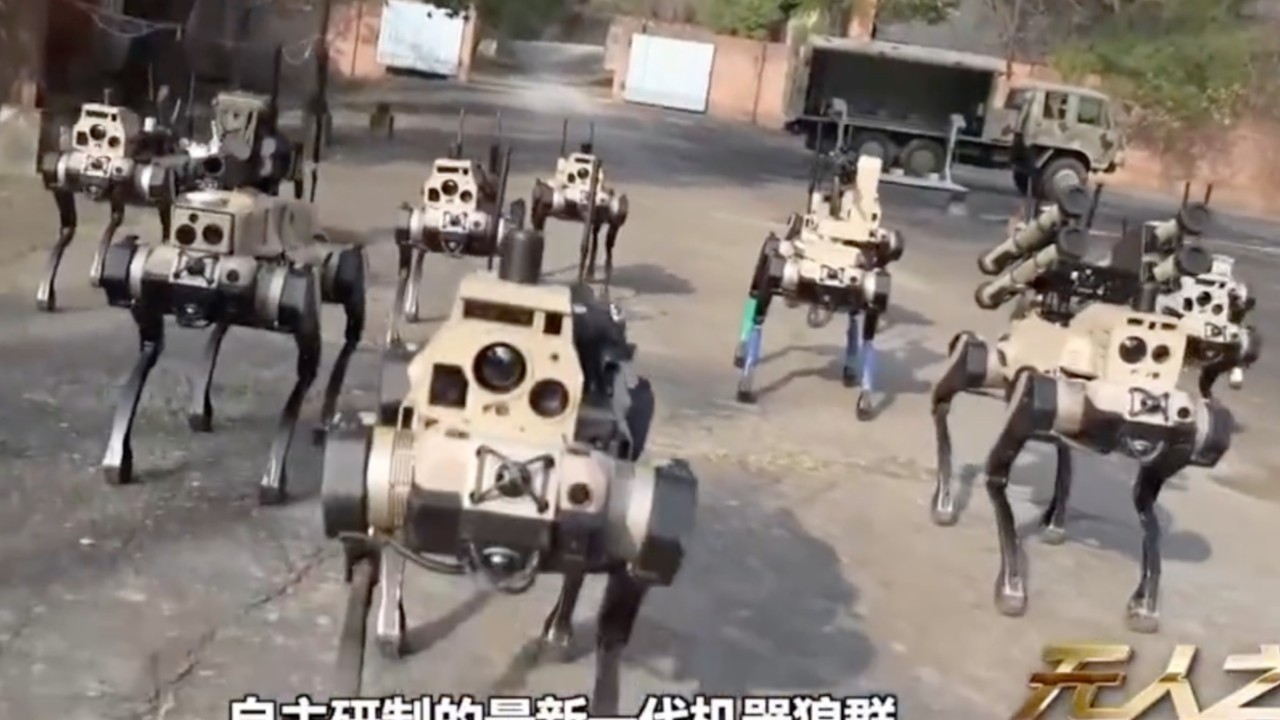
China’s Canine Robots Form Coordinated Urban Combat Wolf Packs
China’s PLA deploys intelligent robotic dog units functioning as coordinated ‘wolf packs’ to enhance urban warfare capabilities. This new approach marks a significant advance from single-unit support to swarm tactical operations, reflecting a strategic shift in autonomous battlefield systems.
China’s military has advanced robotic dog technology into coordinated ‘wolf packs’ capable of complex urban combat tasks. These units share a centralized ‘brain’ enabling synchronized operation and mission adaptability. State media broadcaster CCTV revealed these units represent a major leap forward from earlier single-robot support roles.
The People’s Liberation Army has been testing robotic dogs for reconnaissance and support since 2019, but latest models now operate as intelligent swarms. This evolution addresses challenges in urban warfare where maneuverability, situational awareness, and rapid response coordination are critical against potential adversaries.
Strategically, China’s integration of swarm robotics in urban combat showcases its focus on modernizing force capabilities with AI-driven autonomous systems. Such technology can overwhelm defenders, gather real-time intelligence, and execute multi-pronged attacks without direct human control. It signals a shift towards networked, unmanned combat units in high-density environments.
Technically, these canine robots weigh approximately 25 kilograms, equipped with multi-sensor arrays, communication links, and modular payloads including surveillance cameras and non-lethal crowd control devices. The ‘wolf pack’ operates via distributed artificial intelligence algorithms allowing group decision-making and task allocation, overcoming individual robot limitations.
Looking ahead, the deployment of coordinated robotic wolf packs may accelerate China’s urban warfare doctrines and prompt rivals to develop countermeasures. This development intensifies the AI arms race, raising concerns over autonomous weapon ethics and escalation dynamics in contested urban hotspots globally.