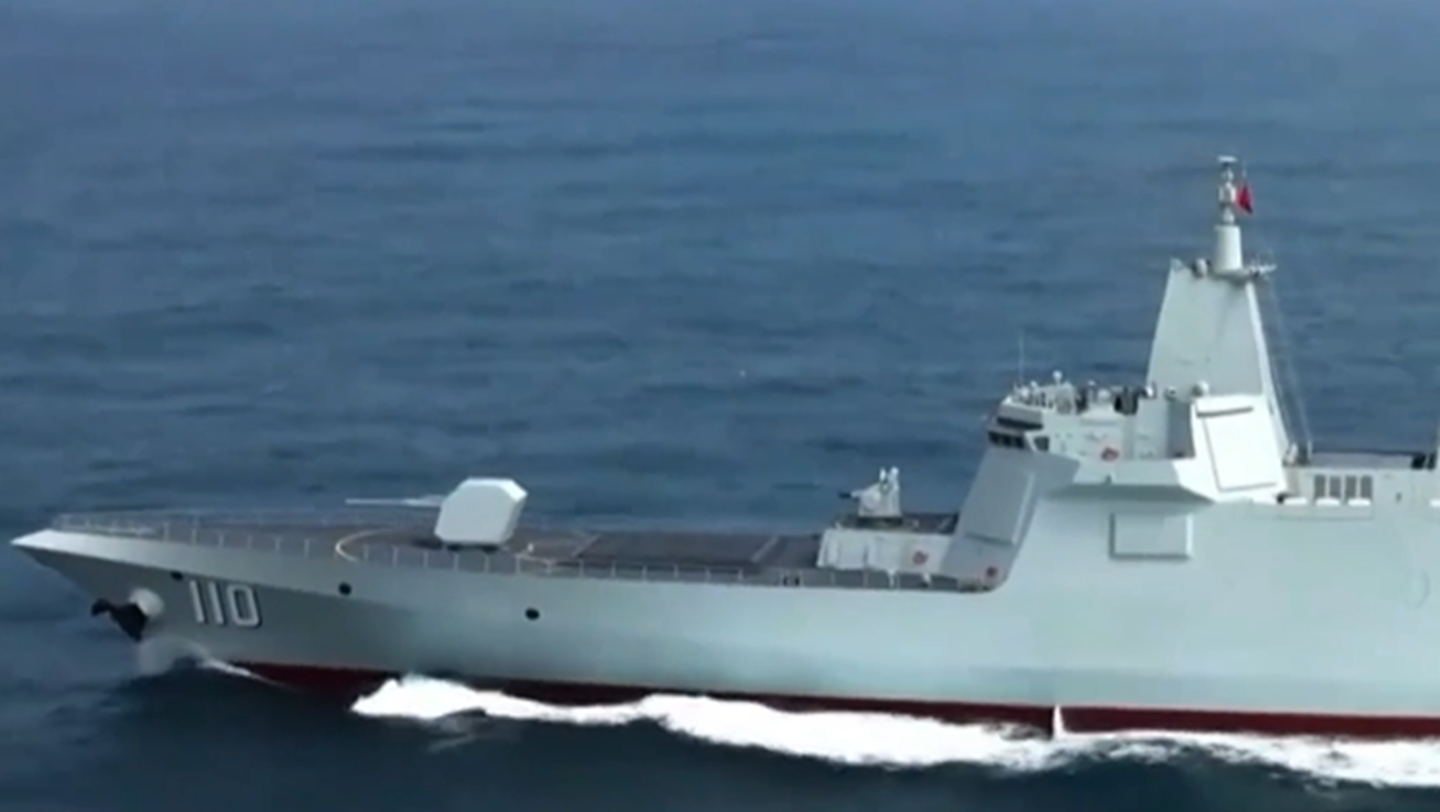
China Expands Naval Power with Ten Type 055 Guided Missile Destroyers
China's commissioning of two additional Type 055 destroyers signals a significant escalation in naval capabilities and regional assertiveness. This expansion enhances the People's Liberation Army Navy's (PLAN) blue-water operational potential amid growing tensions in the Indo-Pacific.
China has commissioned two new Type 055 guided missile destroyers, increasing its fleet of this advanced class to ten vessels. The Type 055 is equipped with state-of-the-art radar and an array of missile systems, including the YJ-18 cruise missiles and HQ-9 surface-to-air missiles. This move highlights China's ongoing military modernization efforts, particularly in its naval capabilities, which are crucial in asserting dominance in contested maritime regions.
The Type 055 destroyers represent a significant upgrade in China's naval power, reflecting years of investment in advanced military technology. Launched in 2014, the development of the Type 055 was a response to regional threats, particularly from the United States and its allies in the Indo-Pacific. As tensions escalate in the South China Sea and Taiwan Strait, the PLAN continues to reinforce its maritime strategy, seeking to project power further from its shores.
This expansion poses a serious strategic challenge to regional adversaries and shifts the balance of naval power in Asia. With sophisticated capabilities, the Type 055 can engage in multi-domain operations, supporting air and land forces while defending against aerial threats. As the PLAN bolsters its capabilities, concerns mount regarding increased friction in maritime disputes, particularly with the US Navy's presence in the region.
Key stakeholders in this development include the Chinese Communist Party, which seeks to solidify its control over maritime zones, and the US military, which views the expansion as a direct threat to its influence. The Chinese claim that the Type 055 serves primarily as a destroyer, but analysts argue its size and capabilities align more closely with that of a cruiser. The strategic ambiguity surrounding its classification serves as a reminder of China's growing assertiveness and its willingness to challenge established maritime norms.
Each Type 055 destroyer boasts a displacement of approximately 13,000 tons and is armed with 112 vertical launch system (VLS) cells. This allows for a versatile range of weaponry, including anti-ship and anti-air capabilities, as well as land-attack missiles. The rapid buildup of these vessels, funded by China's defense budget, which exceeded $200 billion in 2022, reflects a commitment to modernizing the PLAN's fleet.
This development could lead to heightened military engagement in the Indo-Pacific region, with increased naval exercises, patrols, and confrontations between China and rival powers. The operational deployment of these destroyers will not only enhance the PLAN's deterrent capabilities but could also encourage preemptive military strategies among adversaries, further escalating tensions.
Historically, major naval expansions have often led to increased military confrontations, as evidenced by the naval arms race preceding World War I. The proliferation of advanced warships has the potential to ignite conflicts born of miscalculation or miscommunication. The Type 055 could very well be a modern parallel to historical precedents of military escalation tied to naval supremacy.
Looking ahead, intelligence analysts will monitor the operational deployment of the Type 055 and its integration into fleet maneuvers. Observing its impact on US-China naval relations, the frequency and scale of PLAN exercises, and potential updates to regional defense postures will be crucial to understanding the evolving security landscape in the Indo-Pacific. The coming months will be vital indicators of whether this expansion leads to further regional instability or recalibration in military strategies among Pacific powers.