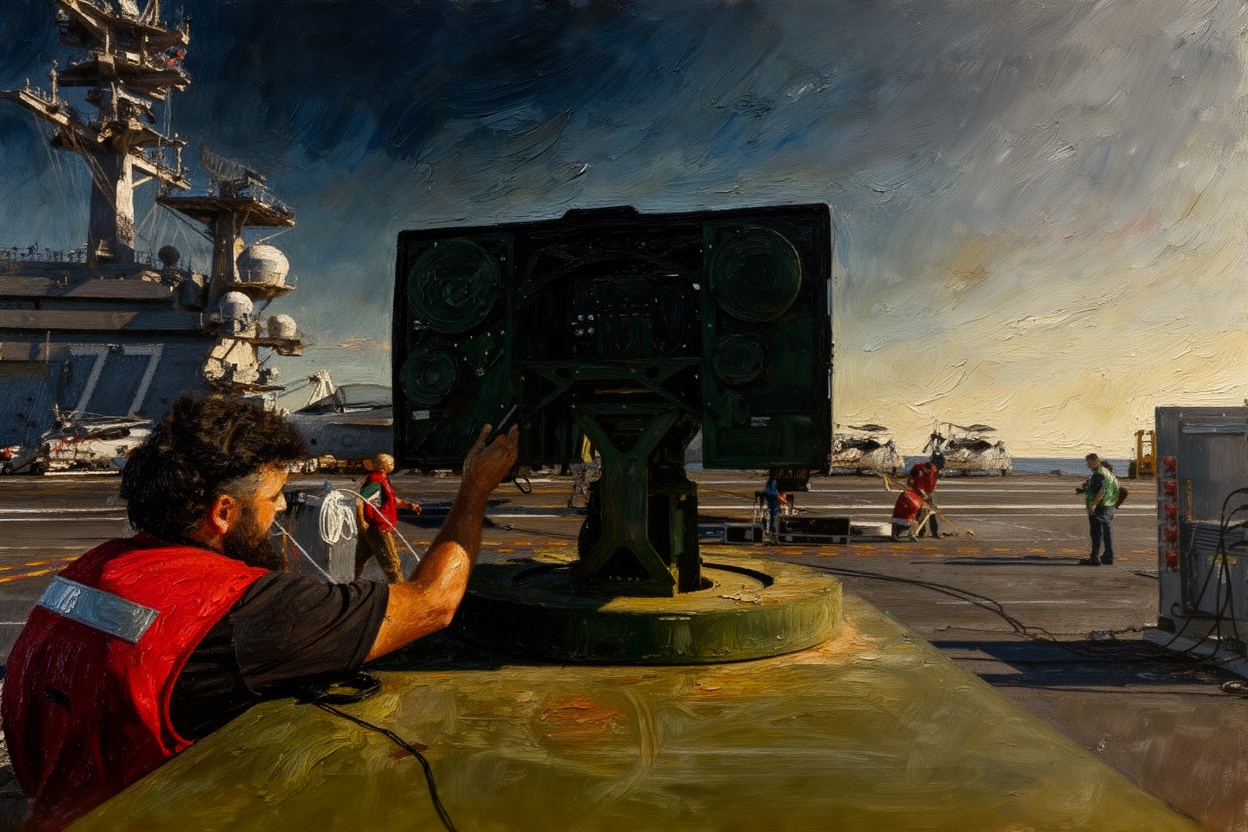
AV demonstrates LOCUST Laser Weapon System aboard Aircraft Carrier
Global security implications rise as AV’s LOCUST LWS shows palletized, shipboard laser capability on a US carrier. Demonstration in October 2025 involved collaboration with the Navy and RCCTO, signaling accelerated path to distributed energy weapons on frontline platforms.
AV has publicly demonstrated its LOCUST Laser Weapon System mounted on a pallet aboard the aircraft carrier USS George H.W. Bush (CVN-77). The event occurred in October 2025 and was conducted in collaboration with the U.S. Navy and the Army RCCTO. The palletized high-energy laser system represents a modular approach to integrating directed-energy weapons on carrier platforms, potentially easing launcher and power constraints for future deployments. The demonstration included a live-fire sequence designed to validate tracking, engagement, and safety protocols in a sea-going environment.
Context for this demonstration places AV’s LOCUST in a broader push by U.S. defense entities to mature palletized, shipboard laser capabilities. The RCCTO’s involvement indicates a cross-agency interest in rapid-acquisition, high-energy laser solutions that can be deployed across varied platforms. The Navy’s participation underscores continued emphasis on hardening maritime force projection with directed-energy options. Analysts will watch how this tech scales in terms of power, cooling, and integration with existing combat systems on large naval platforms.
Strategically, palletized LWS like LOCUST could augment air and missile defense, reduce ammunition costs, and shorten response times against swarming or high-speed targets. While the demonstration focuses on a single carrier, the architecture is intended to be adaptable to other ship classes and potentially allied fleets through standardized interfaces. The operational concept stresses modularity, rapid reconfiguration, and minimized footprint on deck, which could influence future carrier design choices and doctrine.
Technical details from the October 2025 event indicate a palletized high-energy laser system integrated with ship electrical and cooling infrastructure. Specific power output, engagement ranges, and firing limits were described in general terms, but the emphasis was on reliability, handling, and safety during live-fire. The program’s budget, timeline, and industrial partners are expected to shape follow-on demonstrations and potential production decisions for distributed energy weapons across the fleet.
Looking ahead, the LOCUST demonstration may accelerate concerns about allied access to compatible laser interfaces and interoperability. If palletized LWS proves scalable on CVN-77, it could influence carrier air operations by offering an additional layer of defense against missiles and drones. However, questions remain about logistics, maintenance, and risk management at sea, especially under combat conditions. The longer-term impact will hinge on the system’s performance under sustained use and its ability to integrate with evolving onboard sensor networks and command ecosystems.