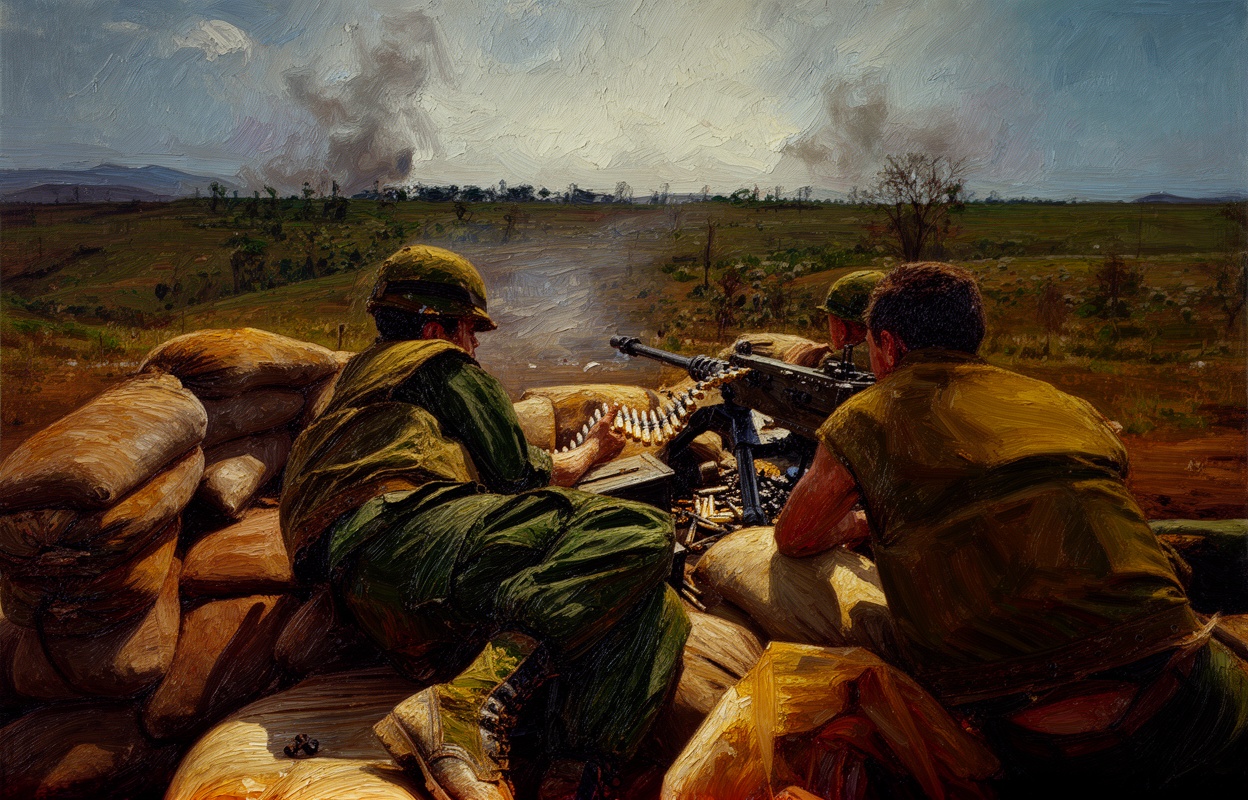
A Century of the Ma Deuce: Browning M2 as America's Workhorse
The M2 Browning, a .50-caliber heavy machine gun, has endured as a core force multiplier for U.S. and allied platforms for a century. Its versatility across air, sea, and ground roles underscores a design that remains relevant amid evolving threats and countermeasures. The piece traces why this weapon has stayed in service, and what that implies for modern defense posture and industrial base resilience.
The M2 Browning has persisted as a decisive force multiplier for a hundred years, adaptable across domains and missions. From its early fielding in World War I-era experiments to decades of aerial, maritime, and ground deployment, the weapon has proven its reliability under harsh conditions. The core design—robust mechanism, high rate of fire, and heavy .50 caliber performance—enabled it to outfight many contemporaries and to serve where lighter systems faltered. Its status as a benchmark in hard-hitting firepower remains evident in ongoing procurement and upgrade programs that keep it current against modern threats.
The weapon’s lineage begins with early 1910s experimentation and rapid refinement under civilian and military oversight, culminating in a system that could be fixed in place or mounted on mobile platforms. Its adoption coincided with changing tactical realities: high-speed aircraft, amphibious operations, and mechanized warfare demanded a gun capable of defeating light armor, aircrew, and soft targets at extended ranges. Over time, variants and mounting configurations expanded its reach—from aircraft wing hardpoints to fleet gun mounts and Humvee chassis—demonstrating a rare blend of simplicity and battlefield versatility. The Browning design philosophy—overbuilding for reliability—proved resilient as threats evolved around it.
Strategically, the M2’s enduring ubiquity reflects both a conservative defense posture and a modular, scalable approach to force protection. In air combat, it delivered sustained suppression and target acquisition support for slower escort craft and ground crews. Naval employment hardened surface defenses, where the weapon’s volume of fire and stopping power constrained enemy small-boat incursions and low-flying missiles in littoral waters. On land, it countered infantry formations, light armor, and improvised threats, while providing a bridge between cold war precedents and modern, networked targeting concepts. The result is a weapon that reinforces deterrence by complicating adversary maneuver and enabler coordination across services and theaters.
Operationally, the M2’s weight, feed mechanisms, and mounting options inform contemporary platform design and integration. Lock-and-load reliability, belt-fed feeds, and high-caliber lethality translate into predictable performance under thermal stress and adverse conditions. Modernized variants integrate improved optics, fire control compatibility, and corrosion resistance, while preserving the core firearm geometry that makes field maintenance possible with limited support. Force structure implications include a continued requirement for trained crew, robust logistics for ammunition, and sustained industrial capacity to produce, refurbish, and upgrade components at scale. These factors collectively shape the defense industrial base’s resilience and readiness.
Looking ahead, the M2 Browning’s persistence signals that legacy firepower can remain decisive even as anti-access/area-denial environments intensify. Upgrades and integration with autonomous or semi-autonomous platforms could extend its effectiveness in contested spaces, while continued lifecycle management sustains interoperability with coalition partners. The weapon’s long track record fosters a credible baseline for experimentation with new munitions and mounting architectures that preserve lethal efficiency without sacrificing reliability. In broader terms, the Ma Deuce embodies a balance between proven, rugged design and incremental modernization that sustains deterrence and rapid response capabilities across generations.