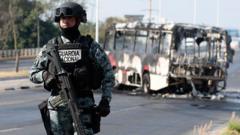
Mexico Deploys 8,000 Soldiers Nationwide Following Drug Lord's Death
In response to escalating violence after the death of a prominent drug cartel leader, Mexico has mobilized 8,000 troops across the nation. This large-scale deployment underscores the government's commitment to restoring order amidst a significant security crisis impacting multiple regions.
Following the death of drug lord Abigael González Valencia, known as 'El Cuini', during a special forces operation, Mexico has activated 8,000 military personnel to address the surge in violence attributed to rival cartel factions. The operation aims to restore security in areas most affected by cartel activities, particularly in states like Jalisco, Michoacán, and Guanajuato, where violence has tripled in recent weeks.
This significant military deployment reflects the Mexican government's ongoing struggle against organized crime and its responsibility to ensure public safety, particularly in the wake of heightened cartel warfare. The assassination of González Valencia has created a power vacuum, leading to violent clashes among his rivals seeking control over drug trafficking routes and territory, destabilizing large swathes of the country.
Key actors in this situation include the Mexican government, led by President Andrés Manuel López Obrador, and various drug cartels, including the Jalisco New Generation Cartel and the Sinaloa Cartel. López Obrador's administration faces domestic pressure to rebuild public trust in its ability to combat cartel violence, while cartel factions are likely to intensify their operations to consolidate power in the absence of El Cuini.
The implications of this escalation are profound, not only for Mexico but for regional stability. Increased violence may lead to higher numbers of civilian casualties and a potential influx of displaced populations. Furthermore, such instability could affect U.S.-Mexico relations, especially concerning border security and anti-narcotics cooperation as it may prompt U.S. intervention or increased funding for Mexican security forces.
Historically, the death of high-ranking cartel leaders often leads to power struggles, resulting in significant increases in violence. Previous cases, such as the deaths of Joaquín 'El Chapo' Guzmán and Osiel Cárdenas Guillén, have demonstrated that such events frequently lead to a spike in clashes between rival groups, with civilians caught in the crossfire.
In summary, the situation in Mexico remains precarious, and while this military response may provide temporary relief, analysts anticipate that without a comprehensive strategy addressing the root causes of cartel power, including corruption and poverty, violence may persist or escalate, leading to further destabilization in the region.