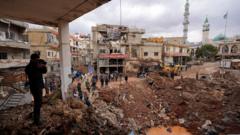
41 Killed in Israeli Raid on Lebanese Village, Major Bloodshed Erupts
A deadly Israeli special forces operation in a Lebanese village has left 41 dead and 40 injured, highlighting escalating tensions along the Israel-Lebanon border. This incident underscores the volatility of regional security dynamics and the potential for further violence.
In a dramatic escalation of hostilities, an Israeli special forces raid in a Lebanese village resulted in the deaths of at least 41 people and left another 40 injured, according to the Lebanese health ministry. The operation targeted remains believed to be linked to historical conflicts, but the sheer scale of casualties raises serious questions about Israel's operational calculus in Lebanon. The raid has sparked immediate outrage and condemnation within Lebanon and across the region, indicating the fragility of existing ceasefires and peace agreements.
This incident comes against a backdrop of increasing tensions between Israel and Hezbollah, the powerful Lebanese militia and political party. For decades, the Israel-Lebanon border has been marked by conflict, including wars in 1982 and 2006, and ongoing skirmishes. The Israeli Defense Forces (IDF) have continued to perceive Hezbollah as a significant threat, particularly due to its growing arsenal of precision-guided missiles and increased military capabilities sponsored by Iran. This raid could signify a critical shift from strategic deterrence to a more aggressive operational approach.
The implications of this operation cannot be understated; it underscores Israel's readiness to execute overt military missions deep within Lebanese territory at a significant human cost. Each escalation raises the stakes for all parties involved, especially with Hezbollah's commitment to retaliate against Israeli incursions. Such operations risk drawing in regional players and further destabilizing the already-volatile Middle East, where proxy conflicts continue to thrive.
Key actors in this crisis include the Israeli government, which aims to reinforce its deterrence strategy against Hezbollah, and the Lebanese state, which may struggle to maintain control over militant responses from various factions, including Hezbollah itself. A deeply fractured political landscape in Lebanon complicates the government's ability to effectively manage repercussions from the raid, and Hezbollah is likely to leverage this event to galvanize support domestically and justify its military posture.
Details regarding the operation reveal an unprecedented level of response, with strategically coordinated assaults that could involve advanced drone technology and precise munitions. The IDF's expenditure on recent military operations has surged, with defense budgets now exceeding $24 billion. This investment represents an aggressive posture that may invite further clashes at both local and international levels, as responses from Hezbollah could involve targeted attacks against Israeli interests.
As the dust settles, the likelihood of retaliatory actions from Hezbollah and other factions becomes a pressing concern. The group has maintained an arsenal reportedly consisting of over 150,000 missiles, many of which have been upgraded to enhance precision targeting. Increased hostility could lead to a renewed cycle of violence affecting civilians and military personnel alike, particularly in southern Lebanon.
This incident bears resemblance to past Israeli operations, such as the assassinations of key Hezbollah figures that often resulted in escalatory cycles of violence rather than lasting resolutions. Historical patterns show that Israel may face heightened risks of conflict escalation following such high-casualty operations, leading to broader regional instability.
Moving forward, analysts should monitor Hezbollah's communications closely for indications of a planned response or further military mobilization. Additionally, any shifts in U.S. or Iranian support dynamics in the region could significantly influence the trajectory of this conflict, with potential implications for U.N. peacekeeping operations along the Israel-Lebanon border. Indicators to watch include troop movements, artillery deployments, and public rhetoric from both Israeli and Lebanese government officials.